Accessibility

 Language
Courage for the circular economy: How new construction methods are making the leap into practice
Recycling and innovative materials show how circular construction conserves resources and can be implemented economically
02.04.2026
Building means taking responsibility - for resources, for land and for future generations.
In the construction industry in particular, it is crucial to decide whether the circular economy becomes a living practice or remains a good concept on paper. The demand for raw materials is enormous and the challenges are growing.
One example is gravel: small stones between approx. 3 millimetres and 3 centimetres in size. In Germany alone, over 560 million tons are used every year for construction activities. This corresponds to 6.7 tons per capita. Although there is theoretically enough gravel in the ground, extraction requires the continuous development of new gravel pits. This also requires permits to be granted and interference with nature. As this is meeting with increasing resistance, it is foreseeable: Gravel will become scarcer in the medium term. Alternative solutions are needed.
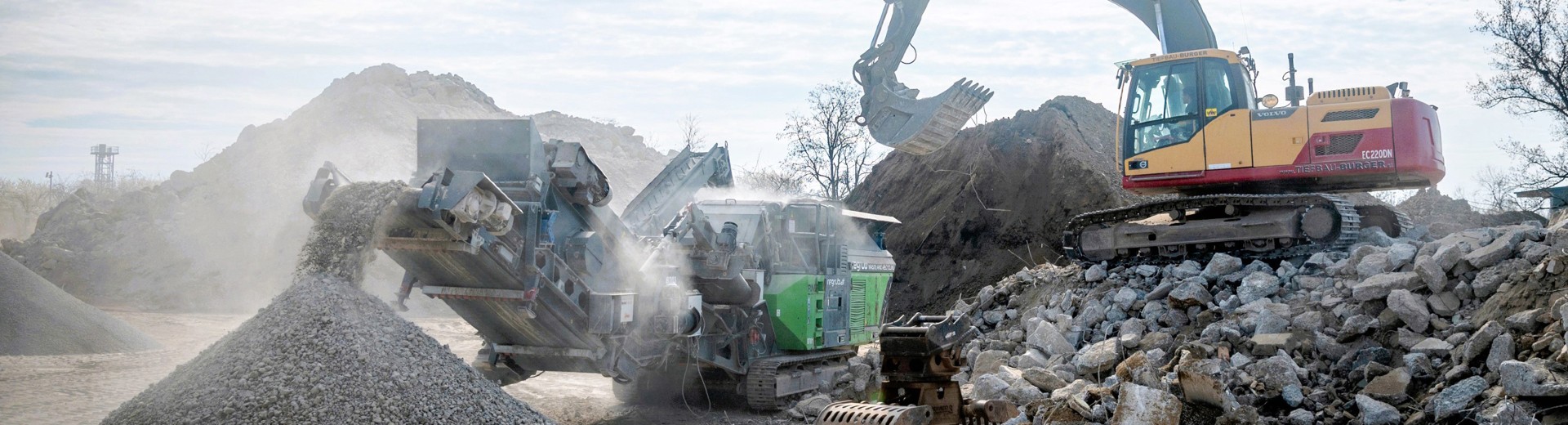
Another key issue is the handling of waste. Around 60 % of all waste in Germany is generated by construction activities. This amounts to more than 210 million tons per year, or 2.5 tons per capita. To date, only a portion of this is processed into new aggregate and can therefore replace natural raw materials such as gravel in construction. This currently only covers around 13% of demand. This clearly shows that there is still enormous potential here to conserve natural resources and consistently advance the circular economy.
The bottom line is that it's all about the circular economy. It is about accepting recycled building materials as being of equal value and developing and establishing innovative construction methods and materials. More and more players, developers, architects and construction companies need to have the courage to abandon the building practices that have prevailed for decades and break new ground. We want to make a positive contribution to this with the RiBa project - using recycling in construction. Together with project partners from Upper Bavaria, Salzburg, Upper Austria, Vorarlberg and Swabia, we are looking for and presenting construction projects on our circular economy innovation map that can serve as role models and inspiration.
Example of residential construction: the St. Vinzenz site in Wangen
On the site of a former nursing school in Wangen im Allgäu, a new quarter with a total of 122 residential units in six buildings was built in 2024. A whole range of innovative materials were used in this showcase project for sustainable construction: 15,000 tons of recycled concrete rubble replaced natural gravel, clinker-reduced cement reduced the CO2 footprint and carbon reinforcement helped to save materials.
You can find more details on our circular economy construction innovation map: St. Vinzenz Areal residential development in Wangen | | ZAB Zukunftsagentur Bau
Example of an administrative building: New building in Tirschenreuth
The Association for Rural Development (VLE) Upper Palatinate has realized a pioneering project with the construction of its new administration building. Innovative solid wood-clay ceilings and "cold bricks" were used here for the first time. Cold bricks are unfired, pressure-resistant bricks that are made from recycled brick material without an energy-intensive firing process. In Tirschenreuth, they are proving their suitability for practical use.
You can find more details on our innovation map for the circular economy in construction: Administrative building Verband für Ländliche Entwicklung | | ZAB Zukunftsagentur Bau
Example of an industrial building: Alberzell production hall
In Alberzell, a production hall was built with a focus on circularity. The aim was to use as many locally available materials and natural resources as possible in the sense of the circular economy, which can later be returned to the material cycle. Despite the sustainable approach, the building is no more expensive than a conventionally constructed one, as the savings made in the disposal of materials meant that considerable costs could be reduced.
You can find more details on our innovation map for the circular economy in construction: Alberzell production hall | | ZAB Zukunftsagentur Bau
The innovation map offers many more examples and continues to grow. It impressively shows how diverse and practical circular economy and circular construction are already being implemented today. Anyone looking for a targeted exchange can find suitable companies and contacts in their own region via the expert network . All these projects have one thing in common: They think ahead - with a view to future developments, responsible use of resources, increasing sustainability requirements and rising disposal costs.
Above all, however, they are the result of people who have the courage to break new ground, make decisions and actively shape the future.
Your contact