Accessibility

 Language
From the steam engine to the production robot: production in transition
30 years of production: industry, change, visions
22.12.2025
In a Bavarian production hall, a workpiece moves autonomously to the next station, sensors measure any deviations in real time and an AI already suggests the optimum setting. These are technologies that were still dreams of the future 30 years ago and are now reality. Bayern Innovativ's Production Innovation Network has been accompanying this change for three decades: from the first digital approaches to networked machines, data ecosystems and AI-supported processes. In the following interview, Dr. Maximilian Bock, Head of the Production Innovation Network, talks about how the production landscape has changed and the resulting opportunities for companies.
What fascinates you about production?
Dr. Maximilian Bock: I have been involved with production technologies since my studies, now for over 10 years. What has always fascinated me is that production is quite a complex area. Today, we think a lot in terms of digital topics, but many of the things that surround us still have to be manufactured.
The smartphone, for example, may be a digital tool, but producing it in large quantities and with consistent quality is not so easy in the end. Because the production methods behind it, processing the different materials and putting it all together into a functioning product that we can buy affordably is really complicated. And that fascinates me.
We in Bavaria are an industrial location. We have many companies that are involved in production, as well as many universities and exciting start-ups in the area. In the context of production, this is a very exciting ecosystem.
Which innovations in the overall production environment were the biggest turning point?
Dr. Maximilian Bock: In the context of changes in production, we often talk about the four great industrial revolutions.
The first was triggered by the steam engine, which brought with it great potential for efficiency.
The second was triggered by the assembly line and electrification.
The third revolution was triggered by automation and the ability to control machines electronically.
In my opinion, the fourth revolution has triggered the central change in the last 30 years. The possibility of networking machines on the basis of the Internet has led to major changes. Today, we are also talking about using artificial intelligence in production and optimizing processes on the basis of data. This was certainly unthinkable 20 years ago. It may not be widely used in all production companies today, but it is already a reality in some places.
Why has Industry 4.0 been one of the key success stories of recent years?
Dr. Maximilian Bock: I was already involved with the topic at the very beginning of Industry 4.0. I wrote my Master's thesis on the topic in 2014. At that time, there wasn't much tangible information on the subject, apart from an implementation paper written by a few clever minds. A lot has happened since then, even if some might say that development should have progressed faster.
There was a lot of conceptual thinking back then. What I find exciting is that, at the beginning, many companies initially looked at the topic for themselves and considered what the networked machines and data could do for them. Examples of this included internal optimization of production processes.
However, it quickly became clear that companies would not be able to realize so much value creation potential on the basis of the concepts alone because they were operating in a complex value creation network. The use of data, for example, only develops great value creation potential if you also use information from others.
I can look at my own production process. For example, with the injection moulding machine that I use to produce plastic parts, I can try to optimize the process based on the parameters that I record in the machine. However, if I don't have any information about the input material in this context, it is much more difficult to really optimize the production process because there may also be differences there.
This is also the case if the material is within a certain tolerance. Many production and manufacturing processes that take place in different organizations, which ultimately result in a product, are very much interlinked. Optimizing all of this as a whole only works across companies and I find that very exciting. There has also been a change in perception over time.
Companies have become more open to sharing their own production data with others. Were there any obstacles?
Dr. Maximilian Bock: There are many reservations, some of which are certainly justified. I think the important thing is that in our role as Bayern Innovativ, we always raise awareness of what is a realistic value creation potential, for example, where the hurdles to implementation are and where the risks actually lie.

So the changes in the production landscape have also had a very strong impact on the work in the Production Innovation Network?
Dr. Maximilian Bock: Yes, exactly. I also see a certain paradigm shift when it comes to digital products. There was a time when many large industrial companies tried to set up digital platforms and use them to sell their own digital services. This led to a landscape with a large number of offerings, which also made it difficult for customers. This is because only a few of the solutions were able to work together interoperably.
And today, with initiatives such as Manufacturing-X or other initiatives in the industrial environment, there is a movement to tackle problems together on a uniform technological basis.
Have customer inquiries to the innovation network changed?
Dr. Maximilian Bock: Today, we receive more inquiries for initial guidance. We can see that the speed of technological development has increased dramatically, and not just for us, but also in many other fields of technology. This is driven by the extreme speed at which digital technologies are developing. And that makes it extremely difficult for many manufacturing companies today to keep track of things. Especially for medium-sized companies that may not have a large scouting or innovation department.
We offer neutral orientation: What are the specific fields of technology? What is the actual status quo? We offer this orientation through the experts in our team and this is also in demand.
Technological developments also mean that fewer and fewer companies are able to overcome the challenges they face on their own. And we also see this in the inquiries we receive. There are more and more requests for contacts in the subject areas that can help the companies, which also go in the direction of an exchange of experience, because the challenges are becoming more and more complex. Especially when it comes to optimizing their own production. Know-how from other areas is also often needed in product development.
Which technologies do you see as key to further advancing the field of production?
Dr. Maximilian Bock: I see two major topics that are already important today, but will certainly become even more important.
One is the use of data in the context of production. I have already mentioned the topic of Manufacturing-X. There are different technological approaches as to how data can be exchanged. But we can see today that even collecting data, i.e. getting to the point where you can do something with the data, is incredibly time-consuming. There are many companies that manually label data, i.e. enrich it with information. Employees sit at a desk, watch video footage and press a button when something happens. More certainly needs to happen for this to generate even more value in production.
The other side is the more physical world of automation and robotics. I also see great potential there for automation and robotics technology to be used to a greater extent in manufacturing companies. A large market is currently emerging in this area in order to be able to use these technologies outside of production.
Does the Made in Germany label still stand for quality?
Dr. Maximilian Bock: Yes. We are not yet able to translate this into products everywhere, but we are still at the forefront in many areas. Take robotics, for example, especially humanoid robotics. A lot of people are interested in this right now because there are videos of robots operating in houses circulating on social media, for example. There are now technology providers from the USA and Asia that are perhaps a step ahead of us. But the research institutes and the start-up world are also at a very good point in Germany and Bavaria. There is still a chance that we will reach a technological situation in which we will be in an even better position in terms of products based on the knowledge that we have in the research institutes and that we can really transfer this technological lead, which we may still have in some areas in terms of research, into these products made in Germany.
One final question: if you could meet James Watt, one of the inventors of the modern steam engine, what question would you ask him about the future?
Dr. Maximilian Bock: That is also something that concerns us today. I would like to know how he managed to create broad acceptance for his technology. The steam engine, even if it probably no longer plays a significant role in production halls today, was once a central component of every production line.
I wonder how he managed to create widespread acceptance for production processes that were previously carried out manually or where other activities were converted to steam power.
In my view, we are now living in two worlds when it comes to some issues. We have this beautiful world of the future, which is perhaps already happening to some extent in science and perhaps also partly in the factories of large corporations. Driverless transport systems are driving around and workpieces are finding their way automatically and there are no more rejects.
In Asia, there are already factories that are de facto dark, i.e. where people no longer work because they are 100% automated. On the other hand, the reality in many medium-sized manufacturing companies is quite different. They are a long way from using these technologies, which have already reached a high level of maturity. This may be due to a lack of investment funds in some places or the complexity of implementation. But I also believe that a certain attitude towards new technology topics is perhaps also partly responsible for this.
This is where we at Bayern Innovativ try to help by demonstrating what the technologies can actually do. We create an overview. We act in such a way that we will hopefully also reach a situation in Bavaria as a production location in which many people are enthusiastic about the technological possibilities and have the courage to develop their production facilities in a direction that will allow them to continue to produce here competitively in the future.
The interview was conducted by Dr. Tanja Jovanovic, Member of the Management Board, Bayern Innovativ GmbH, Nuremberg.
30 years of production: industry, change, visions (12.11.2025)
Which groundbreaking innovations have shaped production over the past three decades? And which ones will revolutionize it in the future? Dr. Maximilian Bock, Head of the Production Innovation Network, shares these and other fascinating insights.
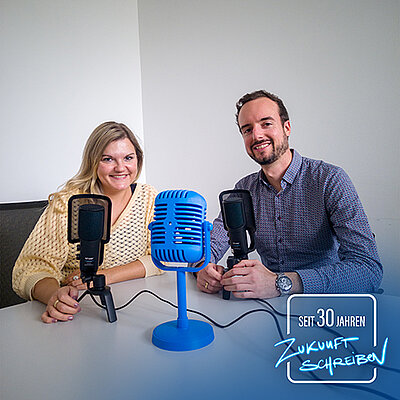
To mark the 30th anniversary of Bayern Innovativ GmbH, Dr. Tanja Jovanovic talks to Maximilian Bock about the breakthroughs that have been made - and why collaboration between business, science and start-ups is so crucial.
Your contact