 Accessibility

 Language
Turning digital ideas into reality: What funding can achieve
The example of ecsec GmbH: successful on the market, multiple awards
31.03.2026
Imagine you have an idea that can change the digital future. But you know it will take time to develop. You need tests, certifications, pilot partners and sometimes even adjustments because rules or political requirements change. And this is where funding can make all the difference. Funding provides innovation, time, stability and sometimes the freedom to realign. The success story of ecsec GmbH is an example of this. That's why I'm talking to co-founder and Managing Director Dr. Detlef Hühnlein and experienced funding specialist Elke Büttner today.
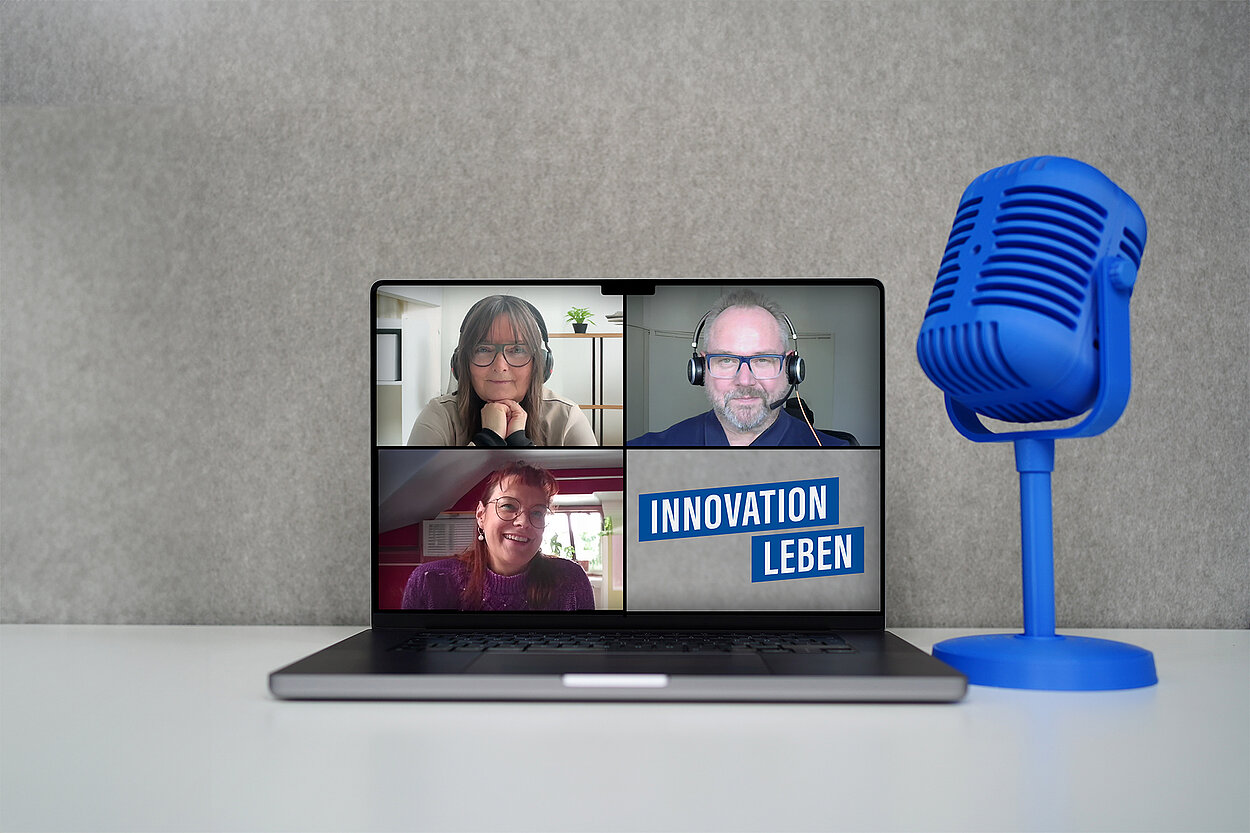
We address the following questions in particular: What was the original funded idea? Why was ecsec more than ten years too early with this vision? And how did funding help us to stick with it and turn change into success?
How did the idea of developing a digital solution for the healthcare sector come about in 2008 and what was the specific idea?
Dr. Detlef Hühnlein: In 2008, a good two years after the legally planned launch of the electronic health card with e-prescription and electronic patient file, we wanted to create a solution that would allow the expected electronic prescription to be filled easily and on the move from home.
ecsec was founded by you and your wife in 2009. Two IT professionals with a shared vision who had previously worked in salaried positions. What was it like for you to become self-employed, also in terms of the associated risk?
Dr. Detlef Hühnlein: After more than thirteen years as an employee, the decision to set up a company was appealing, despite the associated risk. We founded epotheke.com UG in order to support the electronic prescription that was immediately expected at the time. However, our previous plan could not be realized, as the e-prescription was only introduced more than ten years later. We therefore took advantage of the opportunities offered by the existing BayTOU funding program and continued to develop. Instead, we implemented solutions for technologically related chip cards of the eCard strategy, in particular around the ID card introduced in 2010. This is how epotheke.com became ecsec GmbH, which has been driving innovative solutions for the digitalization of healthcare and other processes ever since.
This brings us to the lever, funding. When did you realize that the path would be much more difficult without financial backing?
Dr. Detlef Hühnlein: The realization came quickly when the technical vision was first worked out in concrete terms. It became clear that this project could not possibly be managed by two people. We needed additional staff and therefore also the financial resources to be able to hire them.

What specifically made the funding possible back then?
Dr. Detlef Hühnlein: Back then, we really started from scratch with a blank sheet of paper and initially developed the concept. That was still manageable. But we quickly realized that when you develop completely new technological solutions, you need support. And we received this support for both steps through the BayTOU funding program.
Would you have had the courage to set up your own business without the funding?
Dr. Detlef Hühnlein: We probably wouldn't have done it without the funding. Even if it was manageable in terms of volume, it was the decisive trigger for the start-up.
What role does funding play in the early stages of development - beyond financing?
Elke Büttner: Funding offers a degree of security. Financially, of course, but not only that. By submitting an application and exchanging ideas with the project sponsor, you receive an external assessment of feasibility for the first time. This first signal shows whether it makes sense to pursue the project further or even to take the step into self-employment.
Funding is more than just money - it often provides the first assessment of the viability of an idea.
In the case of ecsec, the moment came that many start-ups know, but not all survive: The company was over a decade too early with the e-prescription.
Did this fundamentally call the project into question - or was it immediately clear that a change of course was needed?
Dr. Detlef Hühnlein: Yes, that was the moment when epotheke.com UG became the larger and more broadly based ecsec. It pursues a similar technological goal, namely to enable trustworthy electronic business processes via modern web technologies and web services, but uses other ID technologies such as the ID card or other European ID cards. Ecsec does the same thing in terms of content, but is more comprehensive and Europe-wide.
How was the original different focus dealt with in terms of funding? Did the funding application have to be adapted afterwards?
Elke Büttner: In fact, adjustments are always possible with funding applications or funding projects. Especially in technology funding, because development and research projects rarely proceed exactly according to plan. And it is therefore also possible to make adjustments to the content. Although the financial framework remains predetermined by the application, changes in content, new priorities or adapted objectives are possible. That was also the case here.
Are the prospects of success always a prerequisite?
Elke Büttner: It is always better to adapt a project than to continue down a path that is clearly not going to lead to success. If we see that a significantly better result can be achieved with appropriate changes, then we go down this path. In this case, the project was merely broadened thematically, but the basic idea remained the same.
This flexibility on the part of ecsec and Bayern Innovativ has paid off: ecsec is now successful on the market, has received numerous awards and the vision of the e-prescription on the digital health card is more relevant than ever.
To expand on the topic of promotion: many people who have a good idea don't know where to start. Which three steps lead most reliably to the right promotion?
Elke Büttner: The first step is to find out about suitable funding programs. Our funding guides, for example, can help you with this by giving you a brief description of your project and then naming suitable programs.
The project can then be planned in a targeted manner, whereby the time required to submit the application must be taken into account.
The third step is to contact the responsible project management organization or funding body at an early stage. Here, depending on the program, you will find out whether a brief description, project outline or the application can be submitted directly.
What typical mistakes are easy to avoid?
Elke Büttner: What you should definitely not do: start too early. Projects that have already been started before the application is submitted can no longer be funded. That's why it's important to gather information first, then submit the application and only then start implementation.
With regard to ecsec: Which funding program was used here, who is it intended for and why was it such a good fit?
Elke Büttner: The program that was used was BayTOU, the Bavarian funding program for technology-oriented start-ups. It is specifically designed for young companies that are planning a technical development or for people who want to start their own business with a new technical product idea. The aim of the program is to support start-ups in promising technology sectors. It was a good fit for ecsec because two highly qualified founders came up with a very innovative idea in the field of eCard services.
What innovation is ecsec currently working on and how can society, i.e. all of us, benefit from it in the future?
Detlef Hühnlein: The innovation we are working on is called Ethic Electronic ID Authentic. Our mission is to establish electronic business processes across Europe and replace paper processes in the long term.
How can Bayern Innovativ, with its wide range of services, help companies to follow a similarly successful path as ecsec?
Elke Büttner: Yes, we provide impetus with our services to help innovative ideas succeed. This can be advice, events, networking with partners and universities, and when a product is ready, we also provide support by participating in trade fairs.
The interview was conducted by Barbara Groll, Media Relations, Bayern Innovativ GmbH, Nuremberg.
Your contact
 Bayern Innovativ GmbH,
