 Accessibility

 Language

What is a patent?
A patent is an industrial property right that gives the owner the exclusive right to dispose of their invention for a period of up to 20 years. Patents are therefore crucial for protecting innovations and ideas and promoting competition and economic development. Patent protection allows owners to use their technologies exclusively and benefit from their investments. It is not permitted to use the patented invention without the consent of the patent holder. This includes the manufacture, offering for sale, placing on the market or importing of products protected by the patent as well as the use of patented processes.
Why a patent?
A patent offers comprehensive protection for technical inventions and is particularly suitable for significant innovations with high economic potential. The advantages at a glance:
- Effective protection of your invention: A granted patent grants an exclusive prohibition right for up to 20 years and protects against imitation by third parties.
- Economic benefit: Patents can be sold, licensed or used as the basis for collaborations - they represent a significant asset.
- Competitive advantage: Patent protection can secure a technological advantage and strengthen the market position. The prospect of patent protection also motivates the development of new technical solutions and strengthens a company's innovative power.
- International protection options: Patent protection can be sought in several countries simultaneously via the Patent Cooperation Treaty (PCT) or the European Patent Office (EPO).
Difference between patent and utility model
| Patent | Utility model | |
| Subject matter | Technical and chemical processes and products | Only products, no processes |
| Examination | Comprehensive official examination for novelty, inventive step and industrial applicability | No comprehensive examination, only formal examination for completeness of the documents |
| Term | Maximum of 20 years | Maximum of 10 years |
| Costs | Higher than for utility models, as comprehensive examinations are required | Lower than for patents |
| Grace period | None | 6 months |
Protection requirements for patents
The following criteria must be met in order to obtain a patent:
- Novelty: The invention must not belong to the state of the art. The state of the art includes all knowledge that was publicly available worldwide before the invention was filed.
- Inventive step: The invention must be sufficiently different from the state of the art and must not be obvious to a person skilled in the art.
- Industrial applicability: The invention must be capable of being made or used in an industrial field.
What you need to know before applying for a patent
- Check patentability: Make sure that your invention is technical, novel, inventive and capable of industrial application. Before you apply for a patent, it is important to thoroughly research whether your invention is really new and does not infringe any existing property rights. In a free initial consultation, our staff can support you in the optimal use of publicly accessible patent search databases (DEPATISnet, Espacenet) by jointly developing an individual search strategy.
- Costs and funding opportunities: Bear in mind that the costs for filing and maintaining the patent can vary greatly depending on the number of countries in which you want protection. Also bear in mind the time it can take from filing a patent application to grant (approx. three to five years). Find out about any funding opportunities for your patent application - our staff will also be happy to advise you on this.
- Application: The application for a patent for an invention at an office such as the German Patent and Trade Mark Office (DPMA) must contain a comprehensive description of the invention that enables a person skilled in the art to understand and carry out the invention. A patent attorney can help you to describe your invention correctly and secure it legally. Free initial consultations are organized by the Bavarian Patent Centre to clarify patent law issues. These take place every Thursday. Appointments can be arranged via our staff (+49 911 20671-939).
- Examination & grant: The DPMA examines patentability when a fee-based request for examination is filed. If the outcome of the patent procedure is positive, the patent is granted at the end (usually after three to five years).
Key points of a patent application
- Application: Filing the patent application with the DPMA, EPO or WIPO.
- Priority: Within 12 months of the first application, priority can be claimed for further applications in other countries.
- Publication: 18 months after the filing date, the patent application is published and the content becomes publicly accessible.
Where do I register my patent?
A patent is territorially limited, which means that protection only applies in the countries in which the patent was applied for and granted. There are various offices where you can register your patent, depending on the countries in which you want protection:
- German Patent and Trade Mark Office (DPMA): Patent protection in Germany
- European Patent Office (EPO): for patent protection in several European countries
Once granted, the European patent breaks down into national patents in the designated countries or, alternatively, you can also apply for a unitary patent. - World Intellectual Property Organization (WIPO): for international patent applications via the Patent Cooperation Treaty (PCT)
This makes it possible to apply for patent protection in several countries at the same time and gives the applicant more time for consideration when selecting the target countries.
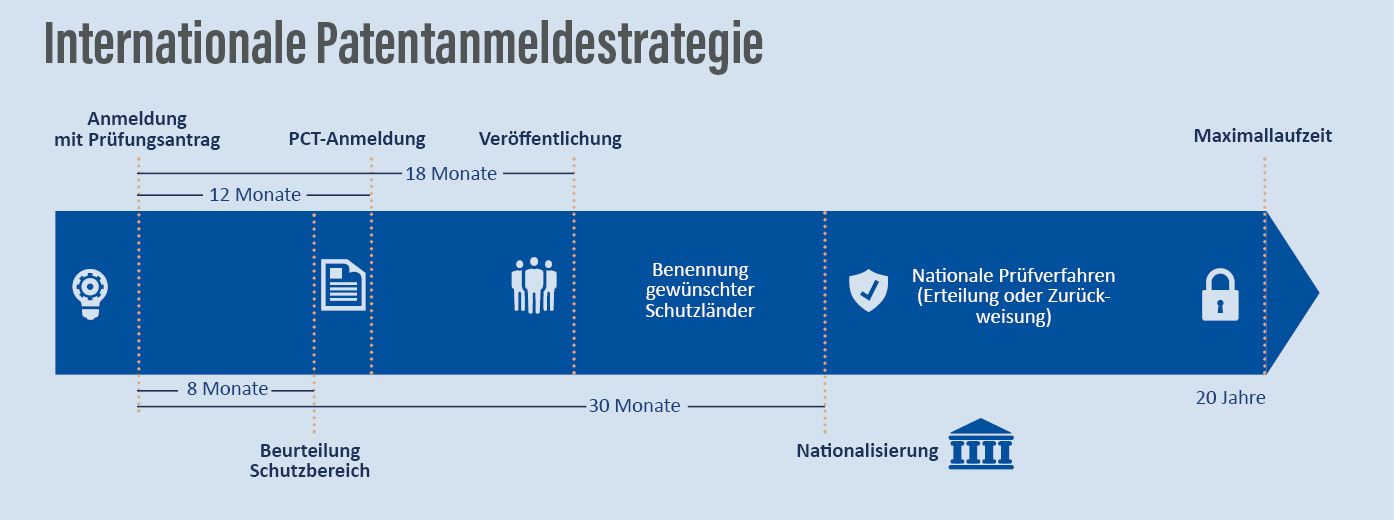
The Patent Center Bavaria offers comprehensive advice on how you can achieve optimum patent protection for your invention. Depending on your target market and budget, you can decide whether a national, European or international application makes sense.
Patent protection - what now?
For commercial exploitation after a patent has been granted, self-exploitation, cooperation or licensing can be considered. In the event of patent infringement by third parties, it is also important to uncover these infringements and take measures to enforce the patent in order to protect your own rights.
A granted patent is not only a property right, but also a strategic instrument for securing and developing your innovative strength in the long term. The Bavarian Patent Center offers various support services so that you can take full advantage of the patent system:
Patent monitoring: stay informed about new intellectual property rights in your field of technology or new applications from key competitors. Through targeted monitoring of national and international patent databases, you can react to developments in the market at an early stage and identify potential conflicts. Track the activities of your competitors in the field of industrial property protection and secure a knowledge advantage.
Patent analyses: Use professional analyses to evaluate your own property rights or to assess the patent landscape of your competitors. This allows you to identify innovation potential and make well-founded strategic decisions. By evaluating patent data, technological developments can be identified at an early stage - a valuable advantage for your innovation strategy.
Advice and training: The Bavarian Patent Center supports you with individual consultations, workshops and training on the topics of patent searches, IP strategy and funding opportunities. Since an invention can be used freely after patent protection expires, it is essential to continuously develop innovations and existing ideas in order to remain competitive in the long term. A sustainable patent strategy can help to exploit the full potential of inventions and maximize their economic exploitation. This is where Bayern Innovativ's Innovation Management department can complement the services of the Bavarian Patent Center.
How can the Bavarian Patent Center help with patenting?
The Bavarian Patent Center offers a wide range of services to support you with patenting. Make an appointment now for your free initial consultation on the topics of patent searches, funding programs and initial advice for inventors or give us a call to find out more about our services.
Your contact

