Accessibility

 Language
City morning, the sun glistens on the asphalt. Her car is parked three streets away. Parked after the night's odyssey of searching for a parking space. She's going on vacation today. Your cell phone vibrates: "Car sharing vehicle available in your area." And yet you reach for the car keys. Why? Because people love the familiar, because routine is more convenient than curiosity. But it is precisely these automatisms, these little mental shortcuts, that can be used. To put sustainable mobility where it belongs: in the middle of our everyday lives. And with heuristics.

Let's clarify this term right away: in everyday life, we humans often make decisions quickly, automatically and intuitively. Our brains have developed a whole range of different mental strategies and rules of thumb called heuristics. In science, we speak of System 1, which is mainly used in everyday life. On the other hand, there is a system 2 with detailed analyses and thought processes, which we use for tricky questions.
However, the application of heuristics has a catch: the results are not always optimal. For example, we don't even objectively weigh up the advantages of car sharing compared to owning our own vehicle. We ignore aspects such as the elimination of fixed costs, no depreciation and the freedom of only having to pay for a car when you actually use it. Or, as in the example at the beginning, we don't even ask ourselves whether a spacious car-sharing van wouldn't make more sense for a vacation than our own small car, which has its advantages when it comes to finding a parking space in the city.
So why do we get into our own car?
Scientists have identified many different heuristics in recent decades. Two in particular influence our daily choice of transportation: firstly, the so-called "status quo bias". This describes the fact that people are reluctant to give up what they are used to, even if this may be disadvantageous for them. This is due to the following mechanisms, among others:
- Loss aversion: we value potential losses more than potential gains.
- Avoidance strategy: We avoid decisions that we could regret.
- Energy optimization: We shy away from the investment of mental resources that would be associated with a change in behaviour.
Secondly, the so-called "availability heuristic" intervenes in our decision-making process. What is mentally present and nearby shapes our judgment. In other words, the more often we see or hear something, the higher we rate its importance or availability. We therefore rate our own vehicle higher than a car-sharing service, as car-sharing vehicles are less present on the street.
Best practices: What can mobility do?
People are aware of alternative mobility options and the negative consequences of environmentally harmful emissions, but they still keep going back to their own car. Who hasn't experienced this? The key is to use psychological insights in a targeted way for the transport transition: People usually make decisions quickly and intuitively, so clever impulses are needed instead of abstract appeals. Two Munich initiatives show impressively how to get new routines rolling.
-
"Go!Family": Finding new routines
To break the status quo bias - i.e. people as creatures of habit - you can start in situations where habits are questioned anyway. This is precisely where the Munich Mobility Department comes in with the Go!Family project: young parents automatically receive information material, discounts and specific offers for sustainable mobility, from a car-sharing membership to cargo bike tests and public transport discounts, which they can use from shortly before the birth until their child's third birthday.
In this example, the status quo bias is used in a targeted way, because young parents are facing a new beginning in many areas of life at this stage anyway. Everyday life is turned upside down, routines have to be rediscovered. It is precisely during these "biographical breaks" that it is easier to question old patterns and try out new things. -
"Let's share, Munich!": Generating acceptance through visibility
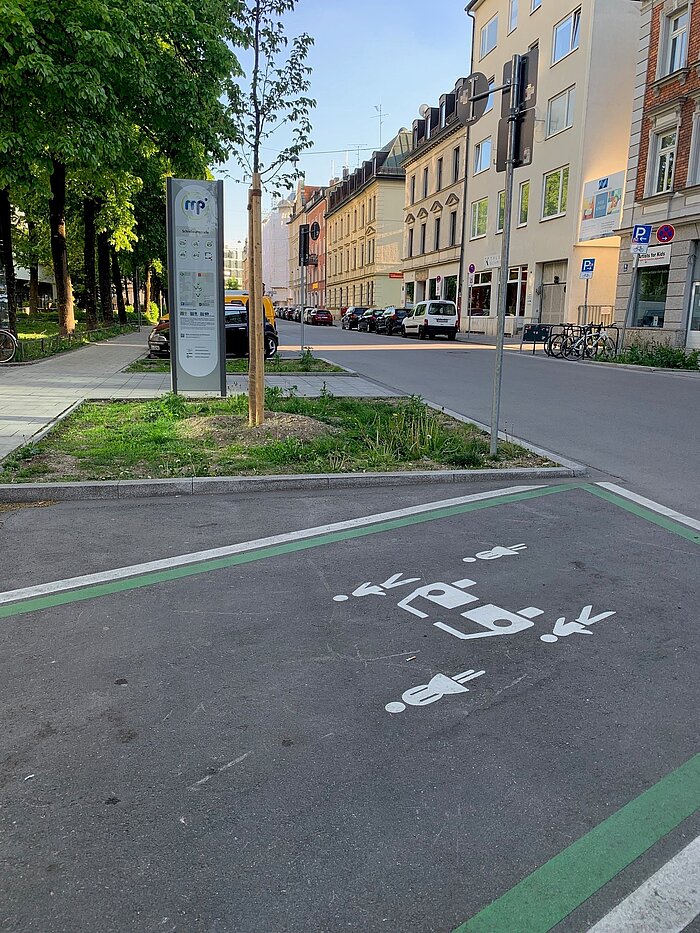
The second example shows how the availability heuristic - we act according to the mental availability of an option - can be cleverly used for the transport transition: Mobility options must be visible in everyday life and accessible at a low threshold. The Munich city council is building new infrastructure for shared mobility on public streets, known as mobility points, by 2026: Hundreds of new car-sharing parking spaces and parking areas for shared bicycles, e-scooters and e-motor scooters are being created throughout the city. The parking spaces are uniformly marked, clearly signposted and thus clearly anchored in the public space. The measure is also accompanied by the "Let's share, Munich!" campaign.
In this way, the availability heuristic can have a direct effect: Because what we see frequently seems significant and familiar to us. Anyone who repeatedly passes car sharing parking spaces on the way to work, when shopping or at the playground (rightly) develops the feeling that shared mobility has long been part of everyday life. Even those who have never used car sharing before are aware of it as an option due to its constant presence. It is no longer just an advertisement on a smartphone, but a tangible option.
Tricks from neuromarketing
Of course, we have one more "sweet treat" to round things off: nudges can be used to consciously steer people's behavior in new directions. Be it through images, colors, words - everything influences behavior and purchasing decisions. The following examples relate to the mobility sector, but can be applied to all sectors:
- Framing Effect: "300 km range - from Berlin to Hamburg on one charge" sounds more attractive than a bare number of kilometers.
- Rule of 3: Three options usually steer customers towards the middle choice - two options seem like coercion.
- Paradox of Choice: Too many options are overwhelming. Few, clearly structured offers make decisions easier.
- Endowment effect: People value things more if they already own them or have been able to try them out. A 24-hour test drive is more engaging than half an hour.
- Power of Free: "Free wallbox" is more convincing than "800 euros surcharge".
- Contrast effect: A 49,000 euro car looks cheaper when it is parked next to a 99,000 euro model.
Such effects are not manipulation, but rather tools to make sustainable decisions more attractive - and to change routines.
Conclusion: From mental rules of thumb to new habits
The transport transition is not only decided at charging stations or by city council resolutions. It is also decided in the mind. Heuristics, such as the status quo bias or the availability heuristic, explain why we cling to old patterns and how we accept new things more easily. Projects such as Go!Family or the Munich Mobility Points prove that good ideas can be turned into real routines through small impulses as well as targeted infrastructure measures. So the message is: mobility does not change overnight, but when the new has become part of everyday life.