Accessibility

 Language
Fuel cells made in Germany
There is "movement" in mobility in the truest sense of the word. Automobile manufacturers have long since recognized that the automobile can only have a future if it meets the increasing demands of the environment and society. The signs are pointing to electromobility, autonomous driving, connectivity and mobility as a service. Alternatives to the internal combustion engine are indispensable, promising approaches there are some - but it remains a major challenge to establish new vehicle and mobility concepts. 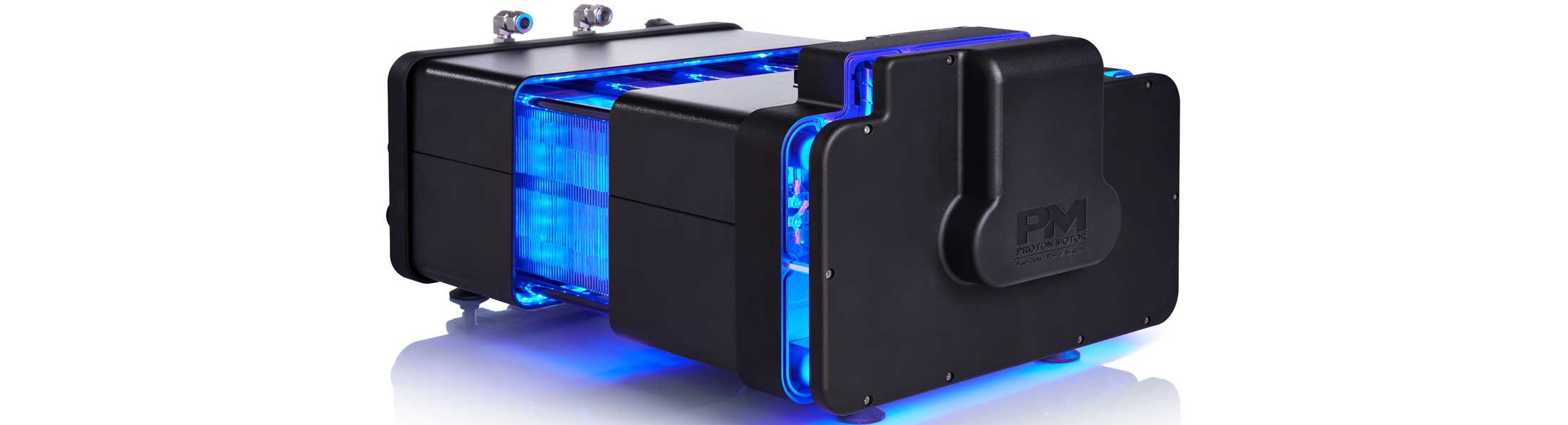 Modular and standardized hydrogen stack modules ranging from 2 to 75 kW. (Photo credit: Proton Motor Fuel Cell GmbH)
The company Proton Motor is a pioneer in hydrogen and fuel cell technology and has set itself the goal of developing and manufacturing sustainable energy solutions for the world of tomorrow in the mobile and stationary sector. With its fuel cells and hybrid systems, Proton Motor offers complete solutions from a single source.
Just recently, the company received a multi-million order from a distributor of electric buses for 15 hydrogen-powered fuel cells of 60 kW each, destined for four German municipalities - a clear sign of increasing demand for hydrogen as a clean energy source.
We spoke with Manfred Limbrunner, Director Sales & Marketing, Proton Motor Fuel Cell GmbH, about current and future applications of fuel cells in mobility and how the acceptance of such solutions can be increased.
Application potentials of fuel cells
Mr. Limbrunner, can you please briefly outline for us which application potentials of fuel cells currently already exist?
Manfred Limbrunner: City buses are currently the most current applications of fuel cells, followed by logistics vehicles. Here, mainly cities are concerned, but also the interurban area. One example of this is our joint venture Clean Logistics GmbH. It is also to be expected that there will be isolated applications for train and ship traffic in the next two to three years. In the municipalities, vehicles are currently used in small numbers, mainly refuse collection vehicles. In addition, there is also potential for forklifts.
What problems do you see in the supply and what would an optimal H2 infrastructure look like?
Manfred Limbrunner: All the vehicles mentioned are vehicles that operate "back to base". An infrastructure problem could thus be solved by a central refueling point, for example, in the depot, as a quick return on investment can be generated here. In addition, certain "clusters" are formed in this way, which can help with area coverage.
How do you assess the value creation potential in Germany?
Manfred Limbrunner: At present, the entire potential is still in Germany. However, it is questionable whether we can preserve it ...
Information about our Conference on Future Automotive Technology
 The CoFAT is a premium event of our Cluster Automotive. (Photo credit: iStock@lookslike)
The Conference on Future Automotive Technology (CoFAT) is a premium event of the Cluster Automotive at Bayern Innovativ and focuses on future technologies in the automotive sector. This year, speakers discussed the key question of whether approaches to mobility and vehicle concepts of the future will emerge evolutionarily or whether disruptive technologies and business models will displace existing ones. More than 300 experts from industry and science met to exchange ideas at the two-day conference in Fürstenfeldbruck. Parallel to the presentations, an accompanying trade exhibition is held each year. FIND OUT NOW!