Accessibility

 Language
Technology Transfer Center Stein: Digital future for emergency medicine
Innovation where every second counts
03.03.2026
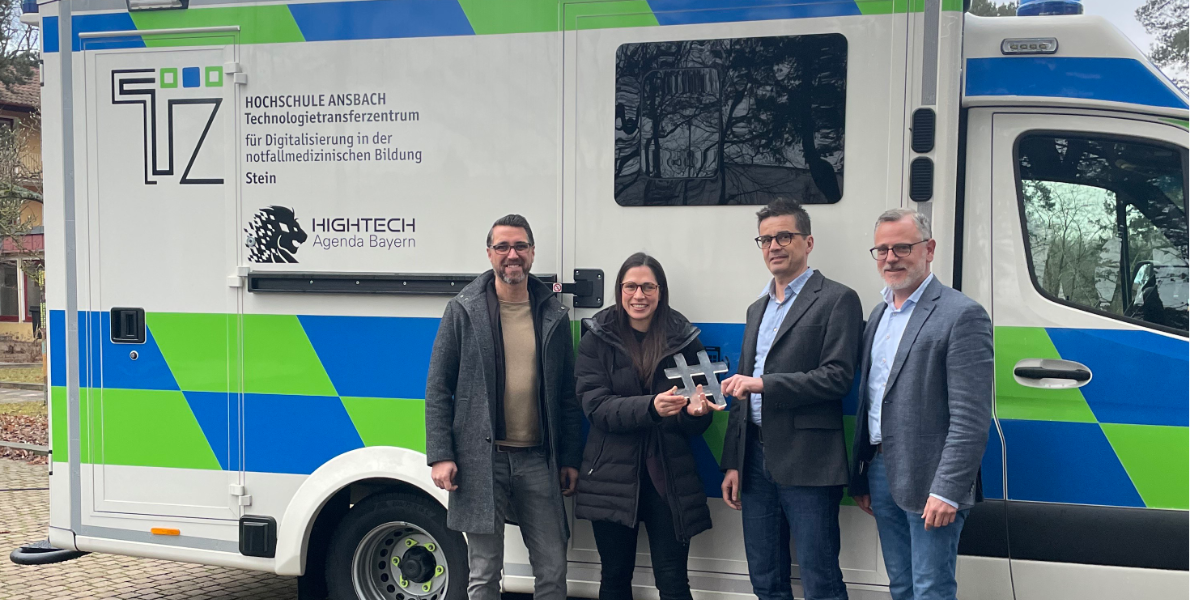
When rescue workers are called to an emergency or have to make complex decisions under time pressure in the emergency room, a lot depends on the quality of their training. This is exactly where the Technology Transfer Center (TTZ) Stein comes in: It sees itself as a pioneer for progress in the digitalization of emergency medical education and focuses on the development and integration of innovative digital technologies to optimize training in all acute and emergency medical work environments.
As a transfer center of Ansbach University of Applied Sciences, founded as part of the Hightech Agenda Bayern, the TTZ Stein combines scientific excellence with practical implementation. Research, development and transfer intertwine here - with a clear goal: to sustainably improve training, processes and patient safety. "Our mission is to consistently drive forward the digitalization of emergency medical education and thus sustainably improve training, processes and patient safety," says Sandra Kretzschmar, Scientific Officer at TTZ Stein.
The center develops and implements innovative digital technologies "for all acute and emergency medical working environments - from rescue services and clinical emergency rooms to authorities and organizations with security tasks".
AI, simulation and data-based processes
TTZ Stein plays a specialized role in the Bavarian innovation ecosystem. As a bridge between science, industry, rescue services and the public sector, it acts as a transfer engine for a safety-relevant and socially central area. In terms of content, the center focuses on digitalization in emergency medicine, artificial intelligence and smart applications, VR and AR-supported simulation technologies, healthcare data analytics and machine learning for process optimization. "AI is not an isolated research topic, but an integral part of our work," emphasizes Kretzschmar. Machine learning is used to evaluate data from training scenarios, analyze decision-making processes and customize training. Automation enables realistic simulations and an objective evaluation of training performance - a decisive step towards improving the quality of emergency medical training. A current international project with cooperation partners in Ukraine is investigating the optimization of triage processes in emergency departments and analyzing digital decision support systems in high-stress care contexts. At the same time, a VR research project is evaluating the effectiveness of immersive emergency scenarios in the classroom and their influence on confidence and decision-making quality. In doing so, the TTZ is addressing key challenges such as the shortage of specialists in the rescue and healthcare sector, the increasing complexity of emergency medical situations and digitalization gaps in safety-critical areas. "We use data-based analyses, simulations and AI-supported learning environments to improve decision-making quality, training realism and process reliability," says Kretzschmar.
Companies - especially small and medium-sized ones - also benefit from the transfer approach. The TTZ supports them from technical consulting to the development of prototypes to the implementation of medical studies and validation in accordance with regulatory standards. "We provide low-threshold access to scientific expertise and test infrastructure, especially for SMEs," explains Kretzschmar.
Data-based training and strong partnerships
A clear trend is emerging for the coming years. "We expect a stronger integration of AI into training systems, the expansion of data-based healthcare research and a close integration of simulation, real-world data and process optimization," says Kretzschmar. In addition, new academic training programmes are to be developed and cooperation with industry and safety organizations is to be intensified. The aim is to establish the TTZ Stein as a leading competence center for digital emergency medical education and research. This opens up concrete opportunities for regional companies: access to state-of-the-art simulation and AI research, co-development of innovative educational and medtech products as well as testing and validation opportunities in a practical environment. The interface between digitalization, medical technology and security is considered a dynamic growth area. What drives her personally? "I'm motivated by the combination of technology and social impact," says Kretzschmar. Innovation in the field of emergency medicine specifically means improved patient safety, more efficient processes and better training conditions.
Strong partner in the health network
As a member of Bayern Innovativ's Health Partner Network, the TTZ Stein deliberately focuses on networking. "Bayern Innovativ's Health Partner Network offers a platform for bringing together research, industry and practice, exploiting synergies and bringing innovation into application more quickly," emphasizes Kretzschmar. For the center, the network is a strategic multiplier for visibility, cooperation and technology transfer. With its clear specialization, its technological depth and its consistent transfer claim, the TTZ Stein enriches the health network with a key competence: the digital development of an area in which innovation can save lives in an emergency.