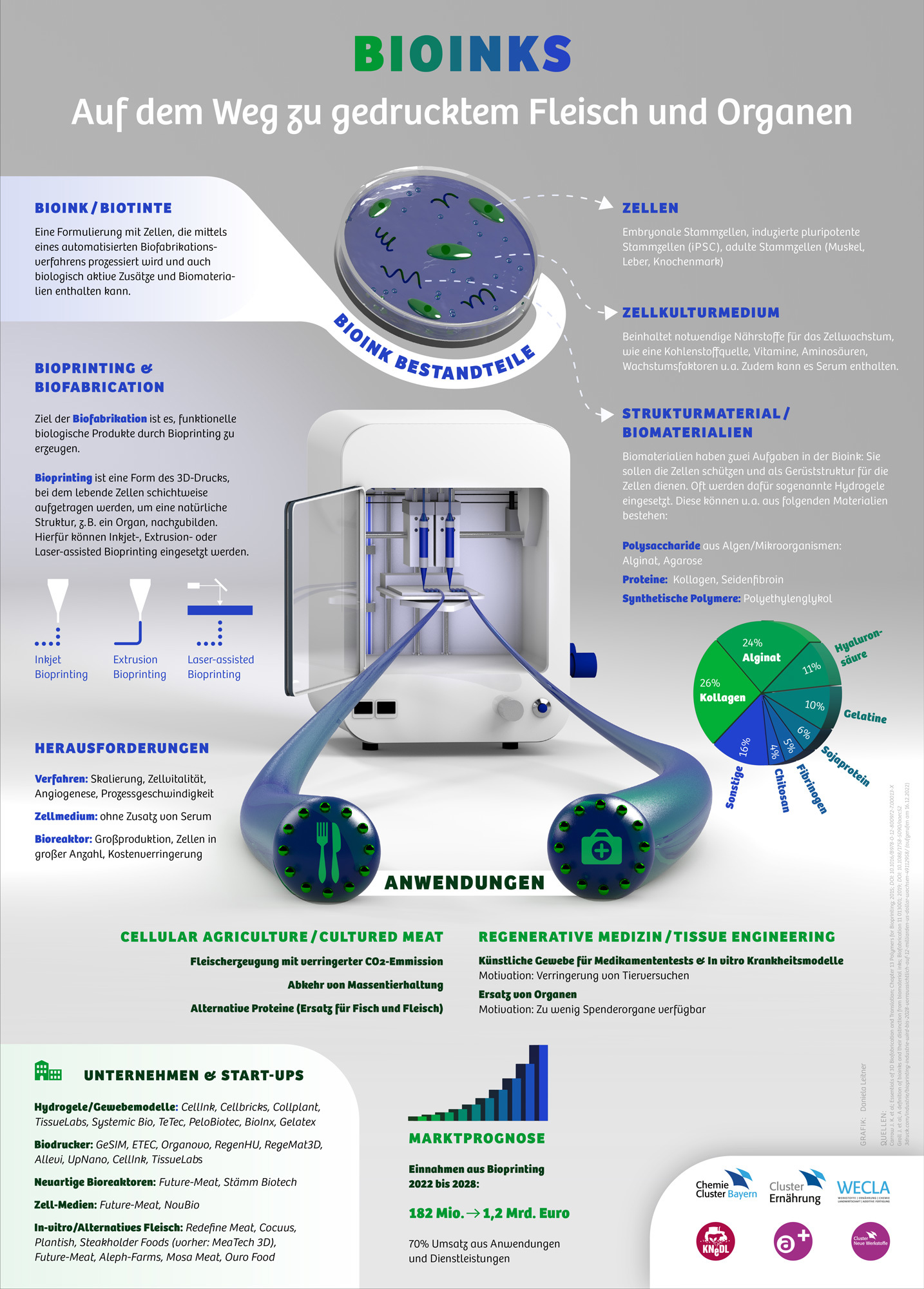
Bioinks as a material system for processing via 3D bioprinting are an enabler technology for the generation of artificial tissues as organ substitutes or laboratory meat. Accordingly, this technology has potentials for biotechnology, medical technology and food industry. In the cross-cluster project WECLA, the New Materials Cluster, the Nutrition Cluster, the Chemistry Cluster Bavaria, the Additive Manufacturing Coordination Office and the Competence Network Digital Agriculture Bavaria have prepared information on future technology fields to show background and application potentials.
What are bioinks or biotints?
Bioinks or biotints are a formulation containing cells that are processed using an automated biofabrication process and may also contain biologically active additives and biomaterials [1]. Biotints are often composed of stem cells, cell culture media to supply nutrients to the cells, and biomaterials. The biomaterials serve as structural materials for cells and can protect them during processing using 3D bioprinting. Hydrogels, which contain polysaccharides, proteins or synthetic polymers, are very often used here as a class of materials. The characteristic, bonding property of hydrogels is their high water content due to a high swelling capacity of these three-dimensional polymer networks.
What is 3D bioprinting or biofabrication?
The goal of the interdisciplinary research field of biofabrication is to create functional, biological products such as artificial tissues. Bioprinting is a special form of 3D printing and encompasses a whole group of processes that can handle bioinks. Well-known processes include inkjet, extrusion or laser-assisted bioprinting. However, completely new processes are also under development, such as ultrasound-assisted bioprinting.
Where are the technological challenges of biofabrication?
The challenges for future industrial applications, which go beyond the laboratory scale, lie in scaling up the processes, increasing the process speed, angiogenesis of the artificial tissues and cell viability. Furthermore, new compositions of cell culture media are being investigated and bioreactors are being developed that work towards cost reduction and large-scale production.
click to enlarge and download
Where are the fields of application?
Bioinks and bioprinting are of interest to the medical technology and pharmaceutical industries. The generation of artificial tissues for drug testing or as part of in vitro disease models can lead to the reduction of animal testing. In addition to the cost savings, the ethical aspects are obvious. Furthermore, artificial organs could compensate for the existing shortage of donor organs.
The production of printed cell-based meat in the laboratory or factory, also known as cellular agriculture, would challenge the concept of conventional animal agriculture. Future benefits could include a reduction in CO 2 emissions and less factory farming. The technology could also be applied in combination with alternative proteins as a substitute for fish and meat.
What about commercial exploitation?
There are already numerous startups around the world dedicated to the technological challenges described. They are working on the development of hydrogels, novel cell culture media to replace fetal calf serum, and innovative bioreactors or bio-printers.
Will the technology be significant in the future?
With the described potential applications in medical care and food production, bioinks and bioprinting can make an important contribution to solving existing challenges. Market forecasts predict that the revenue generated from bioprinting will increase from €182 million in 2022 to €1.2 billion in 2028, with 70% of the revenue coming from applications and services [2].
Sources:
[1] Groll J. et al; A definition of bioinks and their distinction from biomaterial inks; Biofabrication 11 013001; 2019; DOI: 10.1088/1758-5090/aaec52