Trends often trigger blind actionism without any prior consideration of a target-oriented strategy. How digital do our farmer:s really need to be? And what can still be done without?
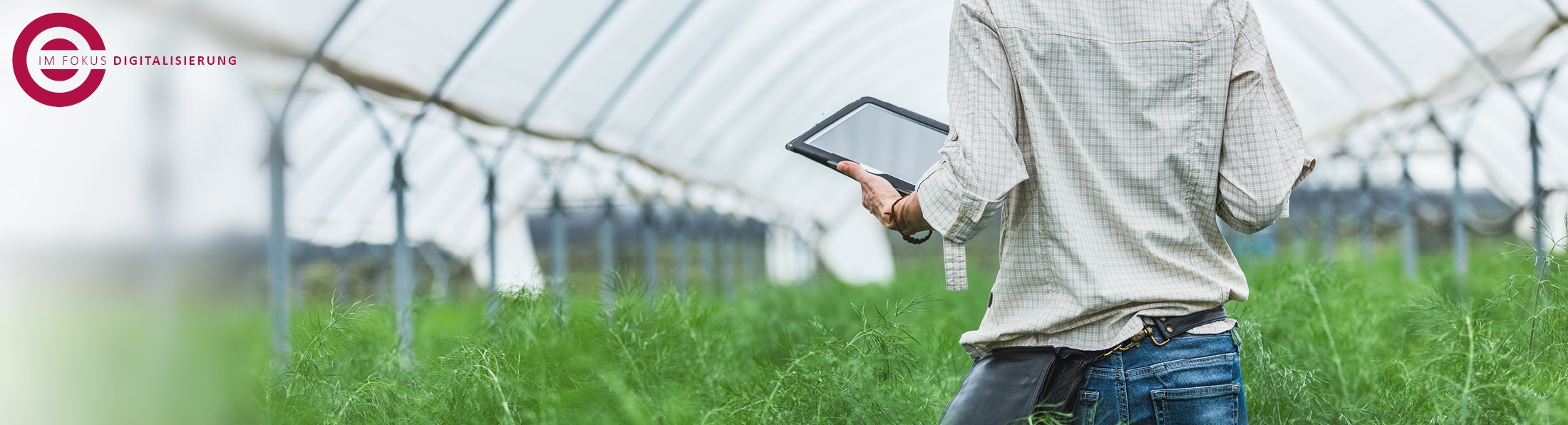
Philipp Horsch: Farmers are already strongly digitized today. From my point of view, this has so far been predominantly about the issue of making work easier - i.e. facilitating steering systems for equipment, field cards for better management in the field, etc. I think that in the future, the focus will be more on products and the needs of consumers. So, digital solutions that create added value for the consumer - for example, complete documentation, such as proof of certain production processes or residue-free production. This is how farmers remain competitive.
I do see blind actionism when manufacturing companies suggest to farmers "Let the computer decide for you and you will have more yields." In my opinion, such promises are a fallacy, because farmers work in nature, i.e. in a heterogeneous environment. And here you will always need people with a good feeling for their work. Only through the combination of expertise, a certain skill and technical work facilitation can one achieve the optimum. I advise against a kind of "recipe agriculture" based exclusively on artificial intelligence (AI).
Mr. Reiter, how well are the "recommended" trends already being implemented by farmers:inside Bavaria?
Heribert Reiter: Mr. Horsch has already drawn a very comprehensive picture of how digital solutions are being used by farmers:inside Germany, who are very open to such applications. However, it is not only the automation of machines that plays an important role. The topics of data processing, yield mapping and recording, for example for accounting, are also important in the entire agricultural value chain. Young affine users in particular are very open and already use such applications via smartphone or iPad. Nevertheless, there are still many isolated applications and the compatibility of data and systems is still a problem. There are - especially in Bavaria - many test farms that give us valuable tips and wishes for handling the digital applications.
But also in the areas upstream and downstream of agriculture, the business partners of the farmer:inside, especially data integrity and data interfaces are a big issue. A smooth and barrier-free transfer of data is necessary in order to create evaluations of fertilizer or pesticide consumption, for example. As everywhere, there are first-movers here who are trying out a lot of things, but most farmers:inside like to have simple, ready-made solutions, quasi plug and play.
 Accessibility

 Language