
Rethinking chocolate: technology for sustainable enjoyment
From kitchen table to global player: Planet A Foods and the value of promotion
27.04.2026
Imagine you love chocolate, but every bar leaves a significant ecological footprint. This is exactly where Planet A Foods comes in: the young company from Bavaria develops cocoa-free chocolate and thus saves up to 92 percent CO₂. Thanks to new subsidized technologies, enjoyment and climate protection are a perfect match.
Find out how an idea became a successful subsidized project and how you too can launch your innovations with subsidies in the following interview with Dr. Maximilian Marquardt, Managing Director and co-founder of Planet A Foods GmbH and Elke Büttner, expert for subsidy programs at Bayern Innovativ.
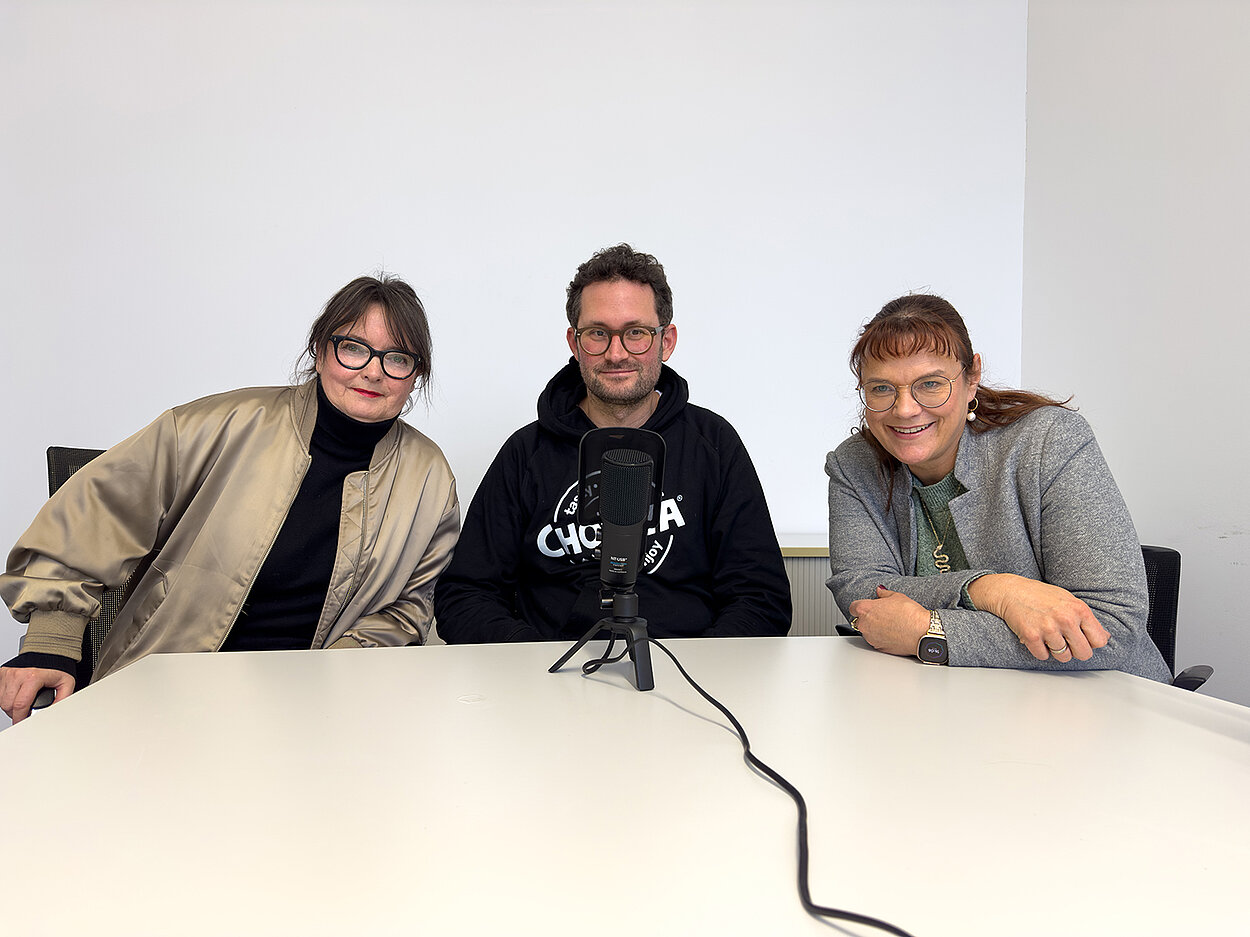
How did the idea of rethinking chocolate and, above all, using modern technology to create a truly sustainable alternative come about?
Dr. Maximilian Marquart: I love chocolate, and so does my sister, with whom I founded Planet A Foods in 2021. The initial idea came from this chocolate indulgence, triggered by the book 'Never Out of Season' by American biologist Rob Dunn. We want to be able to enjoy chocolate for a long time to come. That is why we are not competing against traditional chocolate, but are developing an additional alternative alongside it. Dunn describes in his book that many of today's supply chains will collapse in ten to twenty years due to climate change, droughts, changing weather patterns and more pest infestations. The cocoa plant is particularly affected by this. According to Rob Dunn, global cocoa production could fall by around 50 percent in ten years' time. Today, around five million tons of cocoa per year, 70 percent of which comes from two countries in West Africa on the Atlantic coast, the Ivory Coast and Ghana. In the coming decades, around two million tons of this could be lost, which will be an issue for many large confectionery companies such as Nestlé, Mars and Mondelez. This realization was the trigger for us to start experiments in 2021 to replace cocoa.
We quickly realized that conventional chocolate has a high carbon footprint. This is mainly because cocoa is often grown in areas where there is actually rainforest and a lot of forest is still being cleared for it. This deforestation makes chocolate comparatively harmful to the climate. With our alternative, we can significantly reduce CO₂ emissions.
When you had your idea, it quickly became clear that in addition to a good idea, you also need funding. How did you find out about Bayern Innovativ back then?
Dr. Maximilian Marquart: In the beginning, we financed everything out of our own pockets and started with simple means. Just as Google was created in the garage, our project started in the kitchen with Thermomixes. At some point, it became clear that we needed to professionalize it. So we went to the University of Zurich and the Fraunhofer Institute in Freising to use their machines. Of course, this quickly led to high costs. That's how we finally became aware of Bayern Innovativ.
If I have an innovative idea and want to bring something completely new to the market, I usually need financial support. What steps are necessary for a company to actually receive funding?
Elke Büttner: First of all, it is important to find the right funding program. You should get an overview of which programs are available and which are suitable for your idea. Our funding guides can help with this: they know the funding landscape from Bavaria to the federal government to the EU very well, look at the idea in question and point out suitable programs directly. This means that you don't have to work your way through all the project sponsors and funding offers yourself, but can get an initial orientation straight away. This is particularly important in order to be able to submit the right application in good time.
Once you have found the right program with the help of the funding guides, you can submit your application. It is best to contact the responsible project management agency directly, i.e. the people who manage the program and review the applications. They will give you detailed advice on how the application process works.
We, as the project management agency, also provide support with the application process. Many companies initially have great respect for this because it sounds like a lot of effort and bureaucracy and you quickly ask yourself: Is it even worth it? Can I manage it? This is exactly where we come in. We take the applicants by the hand and support them so that the application is properly prepared and the process runs as smoothly as possible.
You didn't just use one of Bayern Innovativ's funding programs ...?
Dr. Maximilian Marquart: We used all the innovation vouchers, as well as the patent funding program and other funding programs at federal and EU level. The contact with Bayern Innovativ has definitely paid off for us - absolutely.
What should you always look out for when applying for funding?
Elke Büttner: The most important thing beforehand is not to start too early. You always have to submit the application first and wait for feedback. It is possible to start earlier with an 'early start', but this requires explicit approval. It is therefore crucial to make contact at an early stage, as projects that have already started before an application has been submitted can no longer be funded.
In the case of Planet A Foods, the tests in the kitchen were in order. Such preliminary work is always allowed. But the parts of the project that are to be funded later may not be started before the application is submitted. This is exactly where you have to wait until the application has been submitted and feedback has been received.
"As the project management organization, we also provide support with the application process. Many companies initially have great respect for this because it sounds like a lot of effort and bureaucracy and you quickly ask yourself: Is it even worth it? Can I manage it? That's exactly where we come in."
Elke Büttner
Deputy Head of Project Management Agency Bavaria, Bayern Innovativ GmbH
What specifically did you use the funding for?
Dr. Maximilian Marquart: For the first round of funding, we needed functioning samples, i.e. products that go beyond kitchen experiments. That's why we worked at the Fraunhofer Institute in Freising, which provided us with the special laboratory equipment. The funding from Bayern Innovativ enabled us to finance this very expensive development phase for the prototypes and subsequently raise professional capital. We used the subsequent innovation vouchers to further advance our scientific work. Our main focus was on optimizing the taste profile so that we could get as close as possible to a classic Milka Alpine milk, for example.
You now have a lot of experience with subsidies. In your opinion, how important are funding programs for companies - not only when starting out, but also in order to remain successful in the long term?
Dr. Maximilian Marquart: We work continuously with funding programs and always check what can be funded. After all, capital is extremely expensive today, especially for a start-up that is not yet profitable. Every euro counts. In my opinion, this also applies to many other companies that are often working on topics that are very new and whose success has not yet been proven. It is difficult to get private capital for this. That's why funding programs are indispensable in my view. I could hardly imagine this path without them.
You don't just want to make chocolate more sustainable, you also want to completely rethink other foods. That's why you are currently working on a new project, again with the support of Bayern Innovativ. Can you already tell us something about it?
Dr. Maximilian Marquart: I can't say much about it at the moment, at least not in detail. Planet A Foods is not just focusing on chocolate. We are looking at many ingredients that are threatened by climate change. Our chocolate alternative is called ChoViva, and in parallel we are working on several new areas to build a technological platform that will allow us to rethink various endangered ingredients. Some of these topics are currently being patented, so I can't reveal any more yet.
The current funding is not an innovation voucher. What is the funding program behind it?
Elke Büttner: The current program is called BayTOU. Like the innovation voucher, it is about technical developments and new product ideas. The difference lies in the scope: The innovation voucher is the simplest program and primarily supports technical services that are purchased externally at a very early stage because you cannot yet do many things yourself. BayTOU, on the other hand, supports larger development projects and also supports the company's own development efforts.
Does this mean that the new project is significantly more extensive and complex than the previous one and therefore requires different, greater support?
Dr. Maximilian Marquart: We are currently working in several directions. One area concerns new technological developments. Another is much more practical: we have to be able to manufacture our product in large quantities later on. To do this, we need machines, production standards, a functioning supply chain, in short: scalable food production. That's why we are currently planning a second site to build up more capacity. This is a big step that will quickly run into tens of millions of euros: purchasing machines, converting halls, setting up food production. We are also currently looking for suitable funding opportunities and evaluating various locations.
Advice is the be-all and end-all when it comes to funding. What other support is available in addition to the actual funding advice?
Elke Bütter: In addition to the first step towards funding via the funding guide, we not only offer funding advice, but also other services, including via the start-up and transformation guide. If necessary, we also act as intermediaries. For example, we also advise on property rights. Bayern Innovativ also offers many other opportunities to make contacts, for example via networks or trade fair participation as soon as the first products are available. All of this can provide companies with additional support.
If a company still has respect for funding programs and is unsure whether it should take the plunge, what advice can be given from the perspective of a funding recipient?
Dr. Maximilian Marquart: The Bayern Innovativ programs in particular have always been extremely uncomplicated for us. I have very positive memories of them. The applications were straightforward and quick to prepare, and there was always someone available to help with any questions. Decisions were made quickly, we were able to get started quickly and everything was very unbureaucratic. While people often complain about bureaucracy, I didn't experience that at all here. It was actually a great advantage for us to set up in Bavaria because we had access to these programs. That made it much easier for us to get started. In other places, it was much more complicated and time-consuming to get funding. I'm really grateful for that.
One last question: What exactly does the chocolate alternative consist of?
Dr. Maximilian Marquart: It's not easy. We examined around two hundred different alternatives before we made our decision: The basis of our chocolate is now fermented and roasted sunflower seeds. We process them in a special way to create exactly the flavors we know from classic chocolate. That sounds unusual, but you have to know: Around 80 percent of typical chocolate flavors do not come from the cocoa bean itself, but from fermentation and roasting. This is exactly the process we replicate, but using regional raw materials. In Europe we work with sunflower seeds, in Asia with soy. Depending on the region, we use local ingredients. We are now operating globally: in Europe, the USA and also very strongly in Japan. At the confectionery trade fair in Cologne, I met companies from Indonesia who were already familiar with our product and told me that they had even received inquiries about it from Australia. That shows how global we are now. The funding has really paid off for us. We are really on the move, because we have now created around seventy jobs in Munich.
The interview was conducted by Barbara Groll, Media Relations, Bayern Innovativ GmbH, Nuremberg.
Your contact
 Bayern Innovativ GmbH,
