 Accessibility

 Language
16.03.2026
#bayernkreativPORTRAIT: Music, technology and AI: For Mathis Nitschke, these worlds are inextricably linked.
In this interview, he talks about interactive music, new forms of artistic authorship and his CORPUS project.
A conversation about the future of creative work between art, code and community.
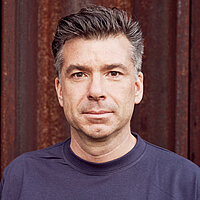
Dear Mathis, tell us... How did you come to combine music, technology and innovation?
There was no single formative moment. I come from a technical background - my father is an engineer - and I experimented with electronics early on. Music and technology were never separate worlds for me, they were equal interests from the very beginning. This dual perspective also shaped me as a sound engineer for a long time.
A decisive shift came much later, about twelve years ago, with the realization that the world has become fundamentally interactive. Linear forms of composition and art, as well as linear media, suddenly no longer seemed to me to correspond to the spirit of the times. This was the starting point for my exploration of interactive media and the underlying technologies and for works such as the audio walk "Vergehen", in which music is no longer just heard, but experienced spatially and situationally.
How did Sofilab come about and what was the original idea behind it?
Sofilab was not founded as a traditional company, but initially as an attempt to reframe artistic work. The name has existed since 2015, when I began to expand my projects to include software developers and the need arose to give artistic authorship a form that points beyond myself.
The name "Sofilab" was chosen deliberately: bright, ambivalent, not clearly male-coded. It was intended to mark a counter-position to the often technocratic and masculine logic of the tech world.
In terms of content, Sofilab was conceived as a laboratory from the outset: as an experimental space to explore, together with partners, which forms of listening and musical experience are possible in a non-linear, networked world. Sofilab was founded as a company in 2017, in the context of the mixed reality opera MAYA, also for pragmatic reasons of liability. But the core was always a research impulse, not a commercial one.
How do you find the balance between artistic freedom and technical innovation?
I'm not sure whether we even need to talk about a balance here. Artistic freedom and technical innovation are not contradictory. The image of the romantic artist on the one hand and the rational technician on the other is a cultural projection, but not a reality.
Artistic work requires a high degree of formal and conceptual stringency, as well as organizational precision. Conversely, technical innovation requires precisely the openness and willingness to experiment that is traditionally attributed to art. In practice, both spheres constantly interpenetrate each other and it is precisely this interpenetration that creates productive friction.
What was the most important learning input from the cross-innovation trip to Ars Electronica?
The trip was characterized by many interesting conversations, which I unfortunately did not follow up on consistently due to a lack of capacity - something I would like to make up for at the beginning of 2026.
However, one key impression was also a critical one: how difficult real cross innovation is. On the corporate side, it was mainly actors who themselves come from the arts and have founded companies who were represented. What was missing were radically different worlds, such as highly specialized engineering companies or medical technology companies - where truly foreign logics collide.
My impression was that art often has more hope for industry than vice versa. Artists are more interested in industrial contexts than industries are in artistic ways of thinking. I consider this asymmetry to be one of the central challenges of cross innovation.
What inspired you to develop CORPUS?
CORPUS was born out of frustration. I had been working intensively with machine learning since 2018, realized my own project and was dissatisfied both technically and artistically. A key problem was the lack of high-quality training material for AI models.
After this experience, I initially paused my AI work and looked into blockchain technology, DAOs (editor's note: DAOs are decentrally organized groups on a blockchain whose decisions are made by code and member votes instead of by a central management) and smart contracts. There it became clear to me that license systems not only remunerate retroactively, but also set incentives in advance: They structure behavior and collective action.
The key question was then: Is it possible to develop a licensing and incentive system that motivates a global music community to build a music library together - as a basis for collaboratively trained AI models, the economic benefits of which in turn flow back to this community?
This question was the genesis of CORPUS.
How can technology give musicians more control over their works?
Technology is not an end in itself here, but an infrastructure. CORPUS sees itself as a protocol - a system of rules and automatisms that can be trusted. The aim is to create a platform that is reliable, transparent and auditable in the long term.
The central promise is not just technical control, but economic participation: CORPUS develops products and applications whose added value flows back to the musicians involved. The organizational complexity of such a system only becomes truly relevant as it grows in size, but this is precisely where the long-term ambition lies.
How has your understanding of artistic work changed?
New media are not replacing old media, they are changing their function. Today, music is rarely listened to in a linear fashion, but is increasingly experienced as something with which one interacts - not just as a consumable work, but as a relationship.
The open question for me is the role of authorship in interactive systems. I don't want authorship to disappear, but I find it difficult to define it precisely in non-linear works. The gaming industry is further ahead here, but I also realize how strongly my thinking is shaped by linear music traditions.
I am particularly interested in forms of spatial and generative listening, from soundscapes and interactive audio walks to non-verbal communication between man and machine. I think the idea of machines reacting context-sensitively to sound is one of the most exciting perspectives that can only be developed using AI systems.
What role would you like artists to play in a technologized music market?
The role of artists does not primarily depend on the market, but on social expectations. In recent years - especially since the coronavirus crisis - the social status of art has shifted. Artists are often perceived as an optional "entertainment factor" rather than as voices to be taken seriously on existential issues.
Historically, this was different at times: in the decades following the Second World War, art was seen as a place of social orientation. Today, these questions seem to be answered more by technology companies, while artists are hardly considered relevant interlocutors anymore.
I think this is problematic. Especially questions like: What distinguishes humans from machines? What is important in life? What do we need to learn if AI can do so much? - are questions to which artists have answers. I hope that these answers will be heard again.
The Bavarian cultural and creative industries are vital, cooperative, polyphonic and relevant to the future. We introduce you to Bavarian players. What is their business model? What drives them?
Would you also like to answer a few questions and be part of our "bayernkreativPORTRAIT" campaign? Then send us an email to kontakt@bayern-kreativ.de with the keyword "bayernkreativPORTRAIT".