26.01.2024
As part of the BMBF project "Additive4Industry - Printed electronics on 3D substrates (A4I-PE3D)", the Chair of Manufacturing Automation and Production Systems at Friedrich-Alexander-Universität Erlangen-Nürnberg is working with Conti Temic microelectronic GmbH, Neotech AMT GmbH, GSB-Wahl GmbH and Holst Centre / TNO in Eindhoven on the fully additive production of electronic assemblies for sensor and high-frequency applications.
Authors: Daniel Utsch, Michael Pfeffer, Jochen Wahl, Hüseyin Erdogan
As the performance of electronic assemblies increases, so do the requirements for improved electrical insulation and thermal conductivity. In addition, planar modules are reaching their limits in terms of design freedom and cost-efficient production of small batch sizes. The FR4 typically used for printed circuit boards often has thermal conductivity values in the range of 0.25 - 0.5 W/m*K, whereas ceramic materials such as aluminum oxide have a thermal conductivity of over 20 W/m*K. The advantages of additive manufacturing include almost limitless design freedom and the cost-effective production of batch sizes of one. The combination of additive manufacturing processes (often referred to as "3D printing") and ceramic materials for base bodies in electronic systems therefore promises to be a promising approach for future 3D electronic assemblies.
For the past three and a half years, the Chair of Manufacturing Automation and Production Systems (FAPS) at Friedrich-Alexander-Universität Erlangen-Nürnberg (FAU) has therefore been working with Conti Temic microelectronic GmbH, Neotech AMT GmbH, GSB-Wahl GmbH and Holst Centre / TNO in Eindhoven on the fully additive production of electronic assemblies for sensor and high-frequency applications using ceramic materials for the substrates. The framework for this was provided by the BMBF project "Additive4Industry - Printed electronics on 3D substrates (A4I-PE3D)" (Project Management Jülich). The mechatronics & automation cluster in Bavaria and Brainport Development in the Eindhoven region provided organizational support and took the lead in networking companies and institutes in the field of additive manufacturing and printed electronics. The four milestones of the project and the respective results are briefly outlined below.
First, the additive production of polymer and, above all, ceramic substrates with low surface roughness for subsequent metallization was developed. The 3D printing process Fused Filament Fabrication (FFF), also known as Fused Deposition Modeling (FDM), was used, in which the starting material is melted in the form of a filament thread in the heated printer nozzle and then deposited in strand form on the print bed, which can also be heated. The movements of the extruder head generate the print image and the 3D component layer by layer. The project primarily used Al2O3 (aluminum oxide) and LTCC (Low Temperature Cofired Ceramics) with the FFF process. Ceramic materials generally require post-treatment steps after printing in the form of a chemical bath and debinding and sintering processes in order to eliminate the non-ceramic component in the filament and to achieve densification of the component and the final ceramic properties. In the project, the manufacturing process of the circuit carriers differed in that the Al2O3 was first completely post-processed before the conductor tracks were printed onto the sintered base body and sintered again, while the LTCC was printed with conductor tracks as a green compact and then subjected to the chemical and thermal post-treatment processes as a metal-ceramic composite (so-called co-sintering). In the latter case, embedded conductive structures are therefore also possible.
The second milestone was the development and application of suitable conductive inks and pastes for the metallization of the printed ceramic substrates. In addition to using commercially available inks as a reference, newly developed silver ink formulations with different compositions and viscosities were tested and iteratively optimized. To create conductive structures on the ceramics, the project used a 5-axis system, which enables the metallization of a three-dimensional surface, and piezojet printing. This process works according to the drop-on-demand principle, i.e. individual drops of conductive ink are applied to a 2D or 3D substrate, which are then condensed into a conductive track in the subsequent sintering process in the convection oven. This already shows an advantage of ceramic substrates over their polymer-based counterparts, as higher sintering temperatures and longer sintering times can be used without damaging the substrate material.
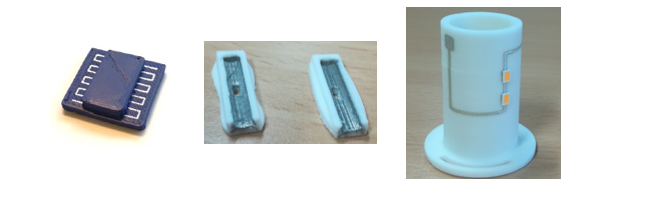
The third milestone was the detailed evaluation of the mechanical and electrical properties of the printed ceramics and their metallizations. The mechanical analysis included determining the surface roughness of the printed ceramic. Extensive studies were carried out to optimize the printing parameters in order to reduce the roughness so that the ink does not run in the grooves of the surfaces during the subsequent piezojet printing. Depending on the nozzle diameter used (0.4 mm or 0.3 mm), Ra values of less than 3 µm or less than 2 µm were achieved. The mechanical behavior of the ceramics as a function of different sintering profiles was analyzed. For the first time, two-step sintering (TSS) was also used for additively manufactured ceramics in a comprehensive study. In the TSS approach, the brown body is quickly brought to a high temperature, then cooled slightly and then sintered with a long holding time. The aim is to suppress grain growth while at the same time increasing the density, as a finer microstructure leads to improved mechanical properties. It has been shown that the thermal profiles have a strong influence on the mechanical behavior. The compressive strength of the ceramics was improved the most by adapting the furnace programs compared to the conventional furnace profile, while the flexural strength improved slightly. The Weibull modulus of the printed ceramics could also be increased; a higher Weibull modulus indicates a higher material homogeneity and a more uniform and finer-grained microstructure in turn leads to better mechanical properties. The investigations of the printed conductive structures on the ceramics concentrated mainly on evaluating the adhesive strength and the specific electrical conductivity. As is common in the field of printed electronics, the adhesive strength was determined by means of a pull-off test, in which a stamp is glued to a round printed pad and pulled off vertically after the adhesive has hardened. The electrical resistance was measured using a four-wire measurement and calculated with microscopically generated geometry data to determine the specific electrical conductivity. It was found that these two properties can be positively influenced by increased sintering times and sintering temperatures after ink printing. A modified ink formulation, which was applied to ceramics for the first time as part of the project, contained an additive as an adhesion promoter, which had a positive effect on the adhesive strength. The overspray (formation of splashes around the print image during the printing process) of the water-based inks on the ceramic was a challenge. In order to reduce this, adjusted printing parameters, a reduction in the nozzle diameter and an increase in ink viscosity were tested. Finally, adhesion strengths were achieved that exceed the state of the art of printed silver structures. Specific electrical conductivities of between 17 and 20 MS/m are also impressive values for printed electronics. In the case of LTCC ceramics, the chemical bath proved to be a challenge for the adhesive strength of the conductor tracks. However, embedded structures could be achieved in horizontal areas. Figure 1 shows a printed layer structure with LTCC ceramic and embedded silver conductor track on the left; an antenna demonstrator metallized with the modified ink formulation can be seen in the middle, and a cylinder demonstrator on the right. The design, iterative optimization and implementation of the demonstrators also represented the fourth and final milestone of the project. This made it possible to demonstrate co-sintering with LTCC ceramics in the context of additive manufacturing; a component with a complex surface in the case of the antenna (internal metallization of the U-profile with small dimensions) could be printed; and the feasibility of additive manufacturing and subsequent assembly of a 3D ceramic component could be demonstrated. In the latter two cases, 5-axis printing was essential due to the existing 3D surfaces.
 Accessibility

 Language