Source: Energy & Management Powernews, October 31 2022
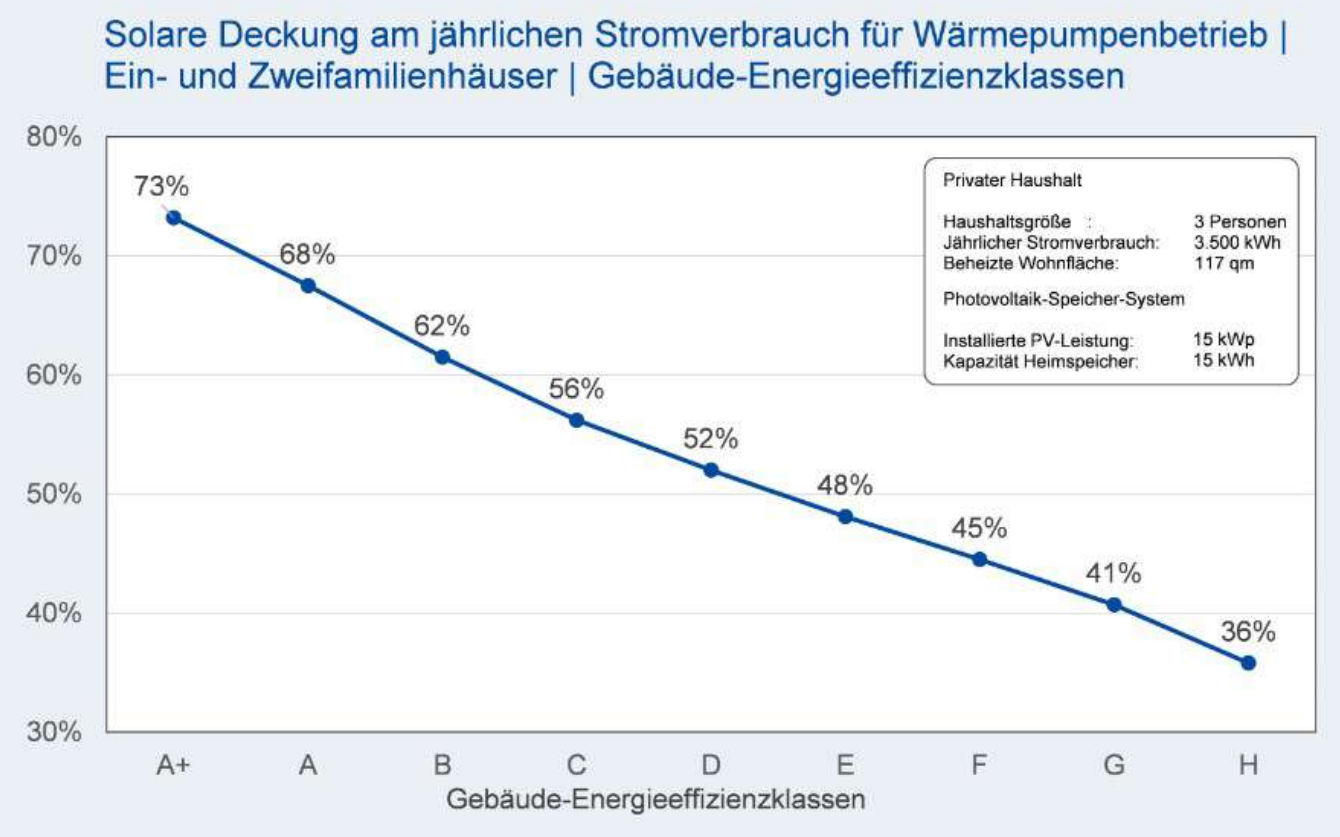
The electricity demand of a heat pump can be covered - depending on the efficiency class of the building - by 73 percent with solar power from the roof. This shows a study by EUPD Research.
Energy consumption and possible savings potential are currently at the top of public interest in view of the energy crisis. The energy demand of heat pumps moves the Bonn market research institute EUPD Research in the focus. The analysis was carried out on behalf of the home storage and charging technology provider E3/DC.
According to the researchers, the energy efficiency class of the building in which the heat pump has been installed has a decisive influence on the energy requirement of the pump. Depending on the energy efficiency of the building, the annual power requirement for the operation of the heat pump can vary by a factor of 10 - between 1,300 kWh (building efficiency class A+) and 13,000 kWh (building efficiency class H).
Background: modern new buildings, which are erected today in the building energy efficiency class A+, come to an annual consumption of heating energy per square meter of less than 30 kWh. If the energy required for heating is reduced to less than 15 kWh, these buildings are referred to as "passive houses. From efficiency class D onwards, the energy requirement rises on average to over 100 kWh per square meter per year. In the class H the energy consumption lies even with over 250 kWh.
The investigation of the Bonner exposes that the majority of the in and two-family houses in Germany exhibits a relatively bad energy efficiency. More than half (55 percent) of the 16.1 million one- and two-family homes fall into building energy efficiency classes F to H. Twenty-four percent (3.9 million) have the lowest energy efficiency class H. The heat requirement of all one- and two-family houses in Germany adds up according to the investigation to 337 billion kWh.
Rat: Generation side of the additionally needed river also plan
With view of the river requirement of a heat pump EUPD Research calls the so-called "annual performance factor (JAZ)" as central size. It describes the ratio of energy supplied (electricity) to energy generated (heat given off). Depending on the heat pump technology - air/water heat pump, brine/water heat pump, water/water heat pump - these factors differ significantly, according to the market researchers. With reference to an analysis of the Fraunhofer Institute for Solar Energy Systems, they name for air-to-water heat pumps in existing buildings an average AER of 3.1, for brine-to-water heat pumps (geothermal), on the other hand, an AER of 3.7.
Another possibility to save on the energy demand of the heat pump, according to EUPD Research, is a photovoltaic system with electricity storage on the roof. Depending on the system dimensioning, the combination of heat pump, PV system and home storage can cover the electricity demand heat pump by up to three quarters with solar power, depending on the efficiency class of the building. 36 to 73 per cent are it concretely, which EUPD Research calls as portion, which could be stemmed by solar power.
 Accessibility

 Language