The Education and Learning Lab for Sustainability Innovations (ELLSI)

29.04.2024

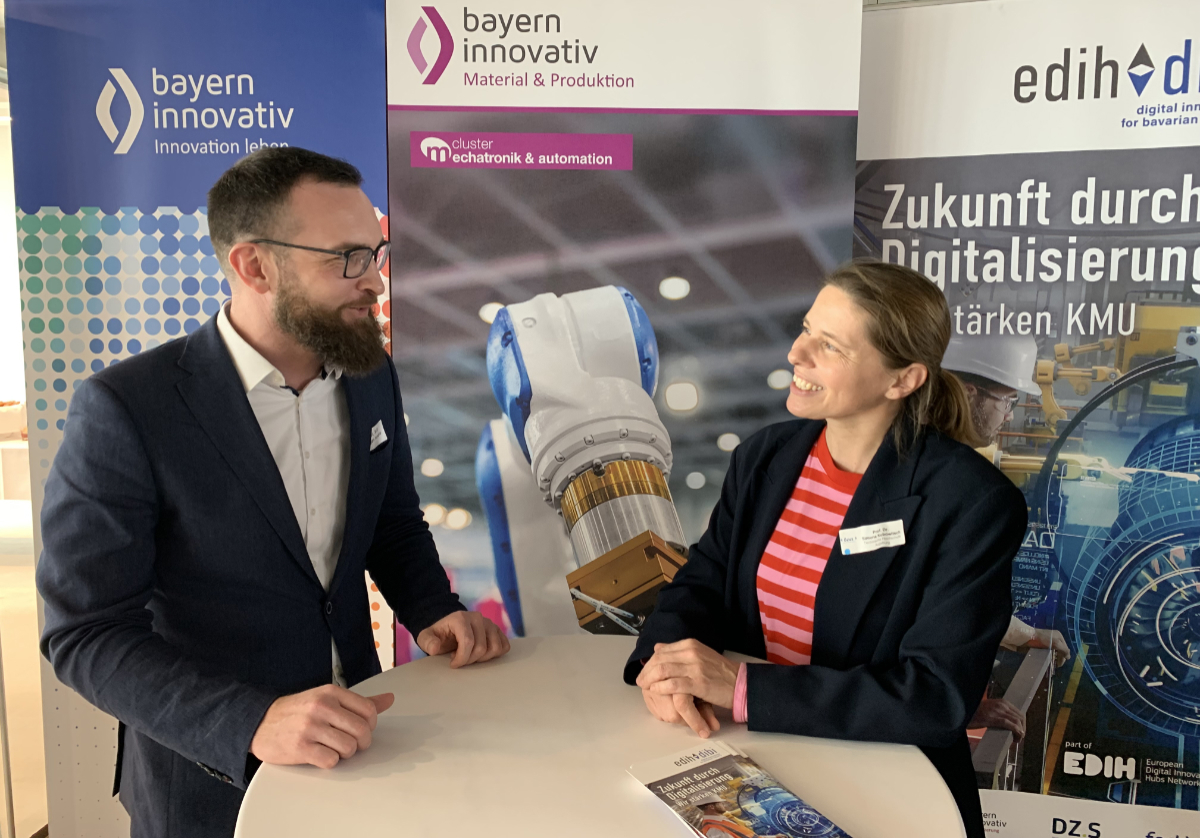
The Education and Learning Lab for Sustainability Innovations (ELLSI), which was made possible as part of the Augsburg University of Applied Sciences' AI Production Network, has now been in existence for six months. As a network partner in the AI production network, Bayern Innovativ, in particular the Mechatronics & Automation cluster, is interested in what is already happening here, how different target groups can participate and what long-term goals are being pursued by the idea providers. Cluster manager Robert Dölle is in discussion with Prof. Dr. Simone Kubowitsch, who is the scientific director in tandem with Prof. Dr. Sarah Hatfield.

Interview Learning Lab Education Bayern Innovativ

Can you explain to us what exactly ELLSI is?

ELLSI is the Education and Learning Lab for Sustainability Innovations at Augsburg University of Applied Sciences and was created as part of the AI production network. Affiliated to the Recycling Atelier of the Institute of Textile Technology Augsburg, the first model factory for mechanical textile recycling, solutions are developed here along a sustainable textile production chain. However, ELLSI's focus goes beyond the textile industry. We offer a platform for sustainability transformations for both regional and national companies. For example, we are working intensively on innovative learning formats for companies and institutions to increase sustainability skills.

What gave you the idea to set up a learning lab?

The initiative for an innovative learning lab for the mega topic of recycling and the circular economy initially came from our university management. It quickly became clear that it was a topic close to the hearts of everyone involved. A forward-looking idea quickly turned into a decision - and implementation.

Which target groups does the ELLSI learning lab appeal to?

The ELLSI aims to ensure the transfer of knowledge on a broad basis. One of our main target groups is SMEs and larger companies, which we accompany on their path to greater sustainability and support in their twin transformation, for example. Based on the model factory for textile recycling, practical impulses and recommendations for action can be developed for all production-related companies in a joint and interlinked approach. We would also like to bring these and other topics into research and society. For example, we are developing participatory formats in which citizens can also contribute to the development of new ideas for recycling and sustainability.

To what extent does your background as a business psychologist play a role at ELLSI?

In my view, quite a significant one. At ELLSI, we use business psychology theories, models and research methods throughout in order to design transformation processes and learning formats for the development of transformative and sustainability skills in a well-founded and effective way. We also draw on our knowledge of business psychology to raise awareness among consumers in order to promote sustainable purchasing decisions. If, as some say, business is three-quarters psychology, then this is probably just as true for sustainability.

Artificial intelligence is currently on everyone's lips. Does AI also play a role in the learning lab?

When developing learning formats for companies to make them more sustainable, we try to consistently think about the link between AI and sustainability. For example, trainees can expand their knowledge and skills in recycling and the circular economy in a playful learning environment with the support of generative AI. We hope that this will contribute to the development of future skills on a broad basis. 

Another example is our strategy workshops and consulting projects for SMEs. We know that in many industries, the change processes associated with sustainability are not considered in isolation from digitalization. That is why we discuss the potential of twin transformation with SMEs. A networked view of these two megatrends, AI and digitalization and sustainability, opens up the prospect of innovative solutions and synergies. One example of implementation would be the development and use of AI-based, company-specific decision support systems. Here too, we can use our background in business psychology to support human-centered and effective implementation.

What opportunities for participation does ELLSI offer to stakeholders in the Bavarian economy?

ELLSI is an open platform for the Bavarian economy. We offer services and at the same time receive signals and ideas. These can be needs for future solutions or innovative approaches from practice, which we integrate into our concepts.

Our services for business include seminars and workshops on sustainability transformations and the development of important future skills. We are also currently creating a Sustainability Innovation Playbook that companies can use in practice. I think that is very promising. Our very application-oriented consulting projects for twin transformation are particularly exciting and interesting for our business partners, in the form of a student project during a semester or as a research collaboration, including, for example, a Bachelor's or Master's thesis with direct practical relevance. At the same time, our partner companies can present themselves as attractive employers.

We can also provide valuable impetus and jointly develop solutions for the future topic of Design for Recycling, especially for the textile industry.

Last but not least, ELLSI is an open place of learning - as a partner for educational institutions and many other interested parties - for example with our Open Atelier on the second Thursday of every month.

How is the idea of transfer put into practice at ELLSI? For us, the transfer of our concepts and tools into teaching and further research at Augsburg University of Applied Sciences, into companies and institutions and into society as a whole is our top priority. We develop suitable formats for each of these areas, for example to investigate applied issues together with companies, with a clear win-win approach. Further practical transfer opportunities arise, for example, from making knowledge from the Recycling Atelier usable for stakeholders.

What makes ELLSI unique?

Uniqueness is, of course, a tall order - I believe that it is our diverse network in particular that makes us unique and sets us apart from others. The interdisciplinary collaboration between experts from psychology, IT and data science, as well as from business and the textile industry in particular, is an absolute must - as is the interlinking of research and practice, with a high level of application relevance for companies and other areas of society. And finally, we are interested in collaborating with partners from the region, but also nationwide. This is how ELLSI stands for synergies from networking.


For more information visit: Lernlabor ELLSI (tha.de)

Recommendation: Experience Prof. Dr. Simone Kubowitsch as an expert at our webinar "From research into practice" on 15.05.2024: Bayern Innovativ - Living Innovation (bayern-innovativ.de)