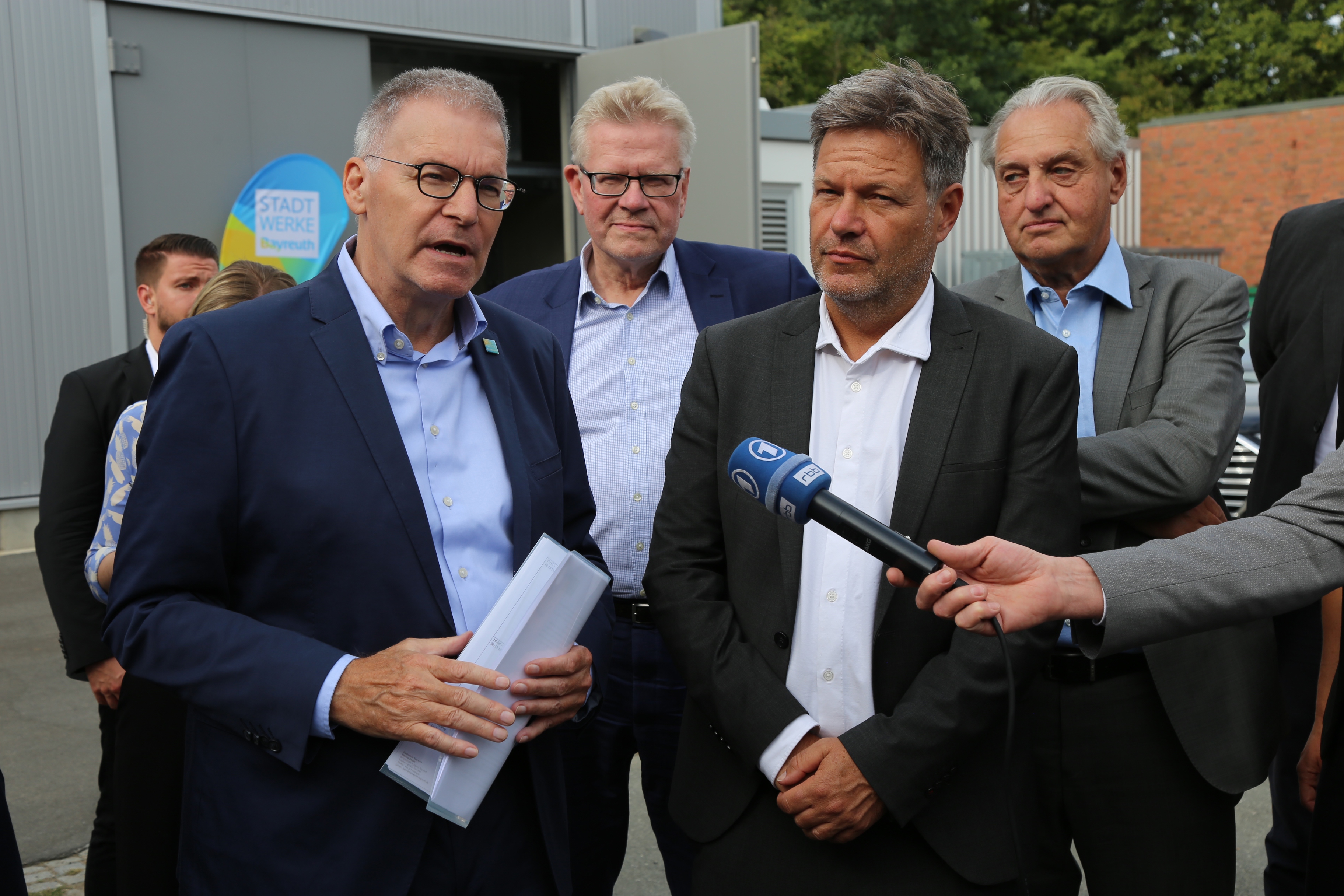
Both Stadtwerke Bayreuth and Thomas Ebersberger, mayor of the city of Bayreuth, have appealed to Habeck that a political solution is needed for people who can no longer afford the sharp rise in energy prices. "On the one hand, there are our exploding procurement costs, which we have to pass on to our customers," Bayer explained. "In addition, there is the announced levy for gas customers, which will also burden many with several hundred euros per year," emphasized the Stadtwerke managing director. In this context, Federal Minister of Economics Robert Habeck spoke of a customer group that has not yet been illuminated - people who do not earn much money. "Because I think I know what burdens can come there, I am clearly on the side of being more generous there," Habeck said.
With regard to security of supply, Habeck stressed that everything was being done "so that we do not get into a situation where it is decided politically that we switch off loads." This step cannot be completely ruled out, he said, but all mechanisms before that are better. Among other things, he said, it's a matter of reducing consumption. "If the German storage facilities are full, they will last for an average winter for two and a half months - without further inflows. But we're getting more inflows: Norway, the Netherlands, the LNG terminals - they'll keep delivering, after all. Then there is the capacity we are building up in Wilhelmshaven and Brunsbüttel. If consumption is then also reduced, as has been agreed at European level, we will be moving within a corridor that does not have to trigger any inevitabilities. That the customers' homes are warm, that's the primacy of the cascades we've built."
Stadtwerke Managing Director Jürgen Bayer also addressed Bayreuth's geographic location in the German natural gas network and the associated concern that the south of the country could run into problems. "Nordstream 1 is in the northeast, so Bayreuth is closer to it than to the northwest. The system would have to be recalibrated - that won't happen so quickly," Habeck said. In the course of this, however, he referred to inflows from the Turkstream pipeline from southeastern Europe, among other things, as well as inflows from Italy. "Inflows from Italy, the Italians tell me, are also secured."
During the visit of the Federal Minister of Economics, Stadtwerke Bayreuth also presented several research projects. One deals directly with the optimization of the iKWKS at the University of Bayreuth. Involved in this is a research alliance of the University of Bayreuth - with the Center for Energy Technology (ZET) headed by Professor Dieter Brüggemann - and the East Bavarian Technical University Amberg Weiden - with its Institute for Energy Technology (IfE) headed by Professor Markus Brautsch.
Robert Habeck was also interested in the ESM-Regio research project, which is taking a close look at the future of distribution grids and is being funded by the Federal Ministry of Economics with around 1.85 million euros. "Bayreuth is a model region in this large-scale project," explained Jürgen Bayer. "It is being coordinated by the Friedrich-Alexander University of Nuremberg-Erlangen under the direction of Professor Reinhard German. The municipal utilities are providing the extensive data basis to be able to explore important questions for the future using simulation models." One pressing question, for example, he said, is how the power grid needs to be structured to handle e-mobility, which is gaining momentum. "Sector coupling is the focus, and hydrogen will also play a role," Bayer said. "We are confident that the Bayreuth model can be transferred to many other distribution grids." German Economics Minister Robert Habeck stressed that this can only succeed with the digitization of the grids.
 Accessibility

 Language