Accessibility

 Language
Additive manufacturing - Is it worth it?
The term "additive manufacturing" covers numerous technologies and processes. Beginners have to deal with many questions regarding the appropriate technology, economic efficiency, material, safety, material and energy efficiency as well as legal aspects. Our technical article provides an overview of the strengths and weaknesses of additive manufacturing.
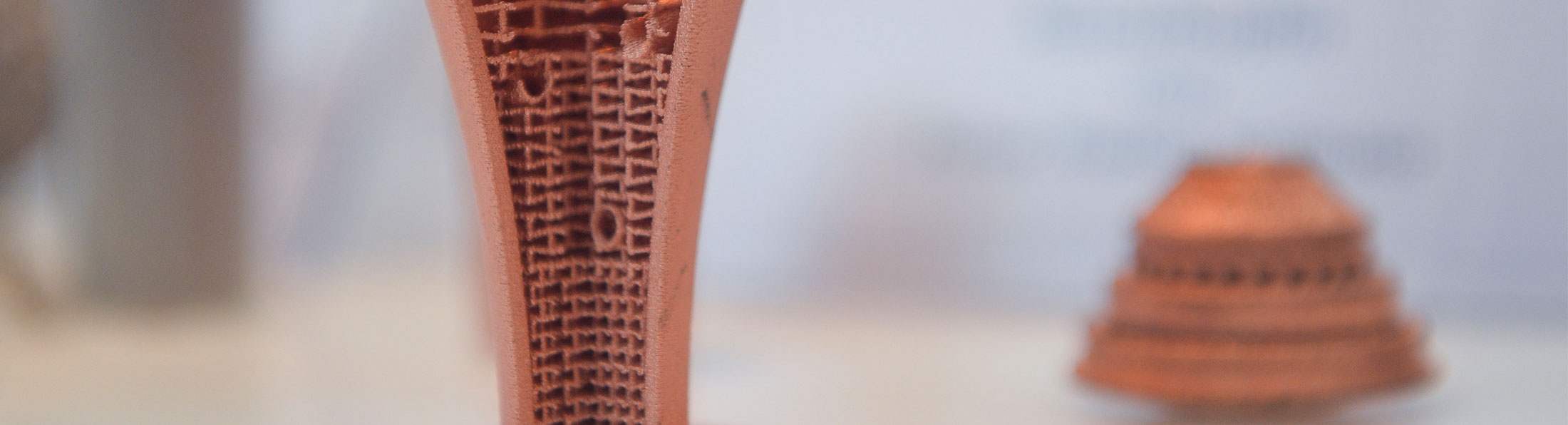 For whom and at what point is it worth using additive manufacturing? Our overview provides information on the strengths and weaknesses of this process. (Photo credit: Bayern Innovativ / Matthias Merz)
Weekly there is new information and developments. Companies that want to get into additive manufacturing face numerous challenges regarding the integration of new processes in their production process. Knowledge gaps, the lack of mindset, uncertainties in risk management, and a lack of vision often cause companies to delay entry.
For these companies, it is especially important to get a comprehensive overview of the technology. Find out here what the strengths and weaknesses of additive manufacturing are and when it is worth using.
Additive processes - these are the strengths
1. Design
Additive processes offer many design possibilities. Complex geometries, such as bionic structures, can be implemented; classical manufacturing technologies cannot keep up here. This means that new designs such as cavities, undercuts, channels with bends or overhangs are readily feasible. A "design for manufacturing" is no longer necessary, because objects can be created purely according to functional usage criteria.
2. Lightweight construction
Additive manufacturing allows the incorporation of thin wall thicknesses and cavities as well as the integration of bionic structures in the components. Especially in the aerospace and automotive industry lightweight construction plays an important role. Thus, additive manufacturing has a very high priority there.
3. Individualization
About additive manufacturing methods, a maximum of individualization can be realized. Components can be manufactured with wall surfaces of different thicknesses, very fine structures or in very small sizes. Especially in medical technology , a high degree of individualization is necessary. Dental prosthetics are a prime example.
4. Development and innovation process speed
Design solutions can be printed directly and tested immediately without breaking the bank. This makes companies independent of service providers who must first produce and then ship prototypes, saving time and money. In the development process, people from different areas work together in an interdisciplinary manner. Tangible printed prototypes facilitate and improve communication and understanding of the development. Potential design flaws are identified early. The use of 3D printers increases satisfaction equally among internal and external customers. Models of prototypes can be viewed and presented. Thus, the best possible solution can be developed. If you want to sell a product, it is difficult to present only a drawing. It is better to show a three-dimensional product as a sales object. This arouses interest and enthusiasm in the customer.
5. Manufacturing speed
The additive manufacturing of an object takes several hours. Manufacturing using conventional methods, especially if mold construction is required, often takes days or weeks.
6. Tool-less manufacturing
No additional tools are needed for the printing process itself. Additive manufacturing allows shaping that cannot be realized with conventional manufacturing processes, or only at great expense.
7. Only one manufacturing device required
Whereas in conventional production processes objects are processed in several steps on different machines, additive manufacturing processes allow components to be manufactured with a single device.
8. Material diversity
The usable materials are diverse. Metals, ceramics, and polymers can be used to realize diverse and complex product properties.
9. Resource/material efficiency
Additive manufacturing processes can also have a positive impact on resources. There is no or very little material waste during manufacturing compared to subtractive manufacturing processes. It is also no longer necessary to produce a mold for components.
10. Quality control and high quality
In laser-based additive manufacturing systems, it is possible to integrate optical systems for real-time quality control. These use the laser light emitted in the "printing" process. Depending on the additive manufacturing process used, high precision and quality can be achieved. It is possible to achieve tolerances of less than 30 microns. The material density for metallic elements is 99% of the raw material. Laser melting does not create voids in the material.
11. Low energy consumption
The energy consumption should also be mentioned positively. The possibility of component production in the own company eliminates the logistical effort. High energy savings are also possible, for example, through the use and spread of additively manufactured lightweight components in the automotive and aerospace industries.
12. Digitization of process chains
Additive manufacturing processes are considered a prime example of the application of Industry 4.0. The processes are based on new information management techniques along an end-to-end digital process chain that enables both horizontal and vertical networking.
13. Short supply chains
Additive manufacturing enables production close to the customer.
14. Cost effectiveness
The cost of additive manufacturing is often listed in both advantages and disadvantages. With maintenance costs included, machine costs tend to compare favorably with other machines. In some industries, such as medical technology, this provides a cost advantage. Additive processes make sense for smaller quantities according to the current state of the art.
Additive processes - these are the weaknesses
1. Production speed
For some additively manufactured components, long production times are to be expected, as only small build speeds are possible.
2. Post-processing
If a certain surface quality must be maintained for an object, post-processing is required. The same is usually true if certain tolerance sizes need to be maintained. Particularly with 3D metal printing, post-processing can be decidedly costly.
3. Industrial mass production
How many parts can be produced simultaneously depends on the machine's build volume. Conventional manufacturing methods, on the other hand, allow the production of much larger quantities. For industrial mass production, additive manufacturing is therefore only suitable to a limited extent. High quantities are thus partly not (yet) economical.
4. Properties
The component and material properties are often dependent on the respective 3D printing process and thus partly very different.
5. Copyright/Patent Law
3D printing offers the possibility to reproduce all possible components. This poses potential conflicts with copyright or patent law .
6. Economic viability
In industry, for example, 3D metal printing complements conventional manufacturing equipment, but does not completely replace it. As a result, additive manufacturing incurs additional costs.
Is additive manufacturing worth it? A look into the future
The additive manufacturing is predicted to have a bright future. Additive manufacturing processes open up new opportunities for companies. They will change production in many industries in the medium term and even revolutionize it in some areas.
Additive manufacturing processes are expected to become widespread in industry in the medium term in fields of application where their benefits can be easily quantified. Major changes are to be expected in the B2B sector in particular. Companies that process preliminary products or semi-finished products from suppliers will be able to manufacture these preliminary stages of the product themselves. Additive processes also make it possible to manufacture spare parts for machinery on site.
At present, additive manufacturing is still competing with CNC-controlled machines, which are superior in series production. However, 3D metal printing can be used very well for complex objects.
About the Additive Manufacturing Coordination Office
Bavaria is already a leading location in the field of additive manufacturing. The "Additive Manufacturing Coordination Office" links many activities related to this topic of the future and serves as a central point of contact for experts and newcomers to 3D printing.
To make Bavarian competencies around 3D printing visible, the coordination office has created an interactive map . Here, for example, companies planning to enter additive manufacturing can find partners and service providers. If you have any questions about the map and/or would like to be listed, we will be happy to assist you with advice and support.