Accessibility

 Language
Resonant rooms in the sawmill
Final performance of the residency program
12.02.2026
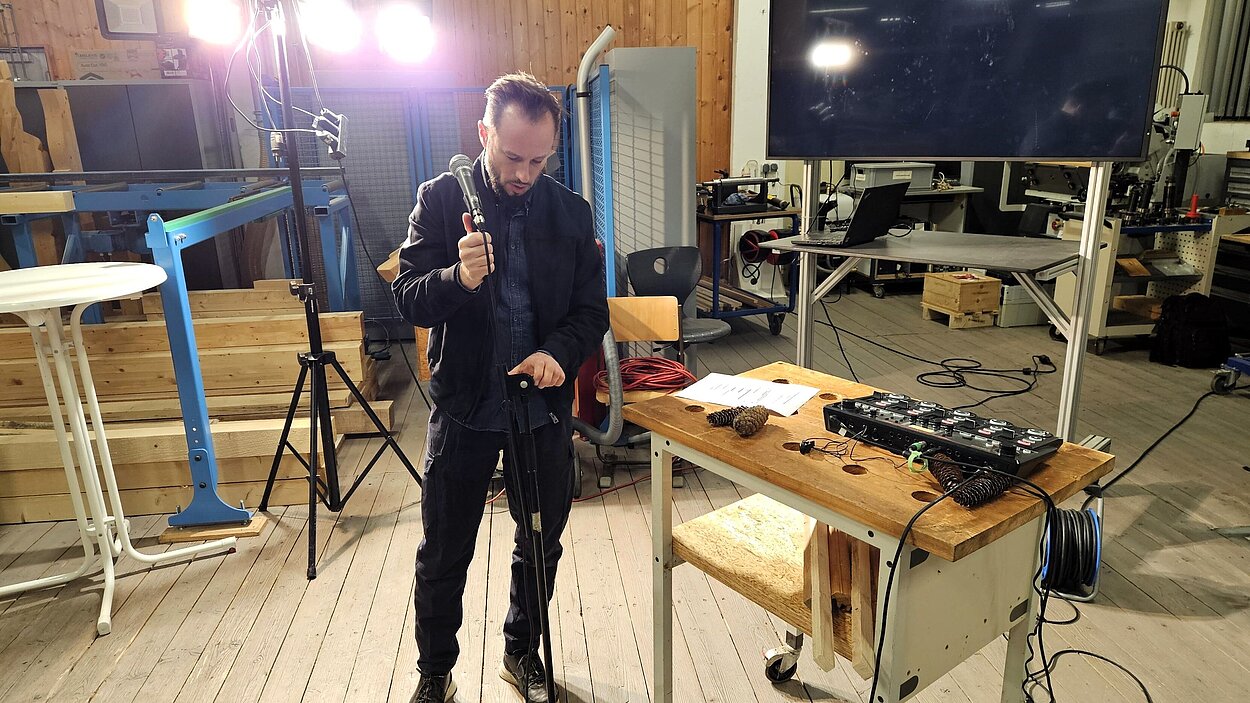
The current residency program as part of the EU Interreg project DECORATOR came to a close with an impressive performance. Around 50 guests accepted the invitation to the sawmill to experience an artistic exploration that combined craftsmanship, wood and architecture in an unusual way.
At the heart of the residency was an intensive exploration of the building itself: its history, its use and the so-called Decorator model. Over the course of several weeks, the artist Johann Reißer explored the site, held discussions with stakeholders and sought an exchange on sustainable perspectives for craftsmanship and building culture. The collaboration with the Holzerband - a student band - lent the evening an additional sonic dimension and combined discourse with atmosphere.
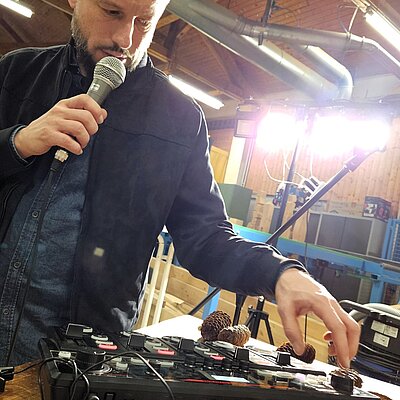
The performance understood the sawmill not only as a production site, but also as a space of possibility. "The sawmill can be a play space that does not have to bow to economic activities. It can create resonant spaces for interaction and enable people to try things out together," was the message during the performance. The site itself thus became the protagonist, as a space for joint experimentation and as a laboratory for sustainable construction.
The focus was on the future of architecture. "The future is not actually something fixed, it is a field of possibility," said Reißer. Architecture can make a significant contribution to this field, provided it thinks beyond efficiency and increased production. Terms such as "Refuse, Reduce, Recycle, Reuse, C2C" were taken up and thought about further: what should machines look like that do not maximize but reduce? Machines that not only produce, but also return materials to cycles?
The performance advocated an architecture that creates connections instead of separating. Away from technical gimmicks and pure design, towards a new approach to materials, better ways of working and living and a residential structure that is not isolated but embedded in processes. A return to traditional craftsmanship was just as important as openness to new concepts.
The basement of the sawmill offered a special moment: there, the artist invited visitors to observe a minute's silence. In memory of all the equipment and machines that were once used here. A silent tribute to the history of the site, linking past and future.
The final performance impressively demonstrated how artistic practice, craftsmanship and architectural discourse can intertwine. The residency program turned the sawmill into a resonating space for ideas, experiments and new perspectives on sustainable building.