Accessibility

 Language
08.01.2025
#bayernkreativPORTRAIT: Pianist Julia Rinderle explains how her early enthusiasm became her artistic vocation. She talks about the Allgäu as a place of inspiration, about music as a language of encounters and her commitment to new perspectives in classical music. In the interview, she provides insights into her multifaceted work as a soloist, lecturer and festival director. Curious? The full interview provides exciting insights into sound, passion and vocation.
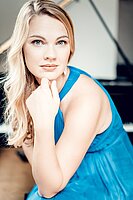
Dear Julia, you started playing the piano at an early age and quickly embarked on the path to professionalization. Was there a particular moment when you realized that music would not only be your passion, but also your profession?
It wasn't a single key moment, but a series of many small experiences in which I realized how naturally music belongs to me and how close it is to my heart. There was a lot of music in my family: My mother is a singer, my siblings played the piano, saxophone and oboe. I always enjoyed listening to them play. Even as a child, the piano was a place of retreat for me - a space where I felt free and focused at the same time. At some point, I realized that I didn't just want to keep this feeling to myself, but share it with others - and that this is exactly what I want to do professionally.
You grew up in the Allgäu, a region that many people associate primarily with nature and tranquillity. To what extent has this place shaped your musical perception?
The Allgäu has had a strong influence on me - through the beauty of nature, its vastness, the incredibly green meadows and fields in spring and summer and this special alternation between closeness and distance.
Nature has also always been a great source of inspiration for my conception of sound and the interpretation of certain passages: the long reverberation in the mountains, the rhythmic change of the seasons, the changing light - all of this provides ideas for the creation of music.
I also try to find this peace and at the same time depth in music - in the sound, in the breath, in the time between the notes.
With the "Klangperspektiven Allgäu e. V." association, you have not only created a platform for exciting artistic positions, but also set a cultural example in your home region. What motivated you to create this festival and what would you like to pass on to the people who attend the concerts?
I founded the association out of a desire to give something back to my home region - and at the same time to create a place where new musical perspectives can emerge. I enjoy creating artistic impulses that arouse curiosity and bring people together.
I hope that people experience the concerts not just as a "cultural event", but as a space for encounters, reflection and amazement - that music moves them in the best sense of the word. The five international masterclasses organized by the "Klangperspektiven Allgäu" association have made this possible time and again. Pianists from all over the world have stayed with host families, among other things, and were thus very close to the Memmingen audience.
In addition to your concert activities, you are also heavily involved in music education, for example with "Rhapsody in School". Why is it important to you to bring classical music closer to young people in particular, and what do you yourself take away from these encounters?
I think music is a language that everyone can understand - you just have to be given the opportunity to experience it. Children often lack this first contact with music. That's why music education projects like "Rhapsody in School" are so valuable: all it takes is one impulse, one "aha" moment, and the access to music is suddenly there. In my work with children and young people, I notice time and again how immediate their reactions are when you take them seriously and don't explain music to them in a dry way, but make it something they can experience.
These encounters are incredibly enriching - they remind me why I make music: because it connects us, no matter how old we are or where we come from.
You take on many roles in your artistic career: Soloist, lecturer, artistic director and music educator. Where do you see the biggest challenges in your everyday life between artistic practice and organizational tasks?
This balance is certainly a challenge. You travel a lot and spend a lot of time on your laptop - especially in everyday life between rehearsals, concerts and organization.
On the one hand, artistic work requires openness, time and inner peace - on the other hand, organizational tasks demand structure, efficiency and quick decisions. I try to see both as part of the same process: Organization as a prerequisite for art to be created at all. At the same time, I take great care to consciously go "back to the piano" every day - to where it all begins.
Is there a project, a topic or an idea that you are currently particularly interested in and that you would like to realize or develop further in the future?
At the moment, I'm particularly interested in how we can integrate the rich, often overlooked heritage of female composers more strongly into everyday musical life. In recent years, I have been able to discover many impressive works. It fills me with great joy to explore this music, perform it and place it in dialog with the known repertoire. For me, it's not just a matter of "complementing", but of gaining a broader understanding of what our musical history encompasses.
I would like to continue to develop projects in which this perspective naturally resonates - be it in concert programs or in my work with students. For me, playing music by female composers means opening up sound spaces that have long been closed - and that is precisely what I consider to be one of the most beautiful tasks of my profession.
I'm also currently thinking a lot about how we as musicians can find new forms of communication - both on stage and beyond. I would like to continue developing projects that bring classical music and society into closer dialog with each other: be it through interdisciplinary formats, portraits of female composers or participatory concert ideas.
The Bavarian cultural and creative industries are vital, cooperative, polyphonic and relevant to the future. We introduce you to Bavarian players. What is their business model? What drives them?
Would you also like to answer a few questions and be part of our "bayernkreativPORTRAIT" campaign? Then send us an email to kontakt@bayern-kreativ.de with the keyword "bayernkreativPORTRAIT".