Printogami: When 3D printing meets origami | Mario Marinovic
26.02.2026
Origami has long been more than just paper art. In space travel, origami principles are used to stow large structures - such as solar sails or antennas - in an extremely compact way and unfold them in orbit in a controlled manner. Well-known examples are the "flasher" and the "Miura fold", which is characterized by a kinematically coupled and precisely controllable movement.
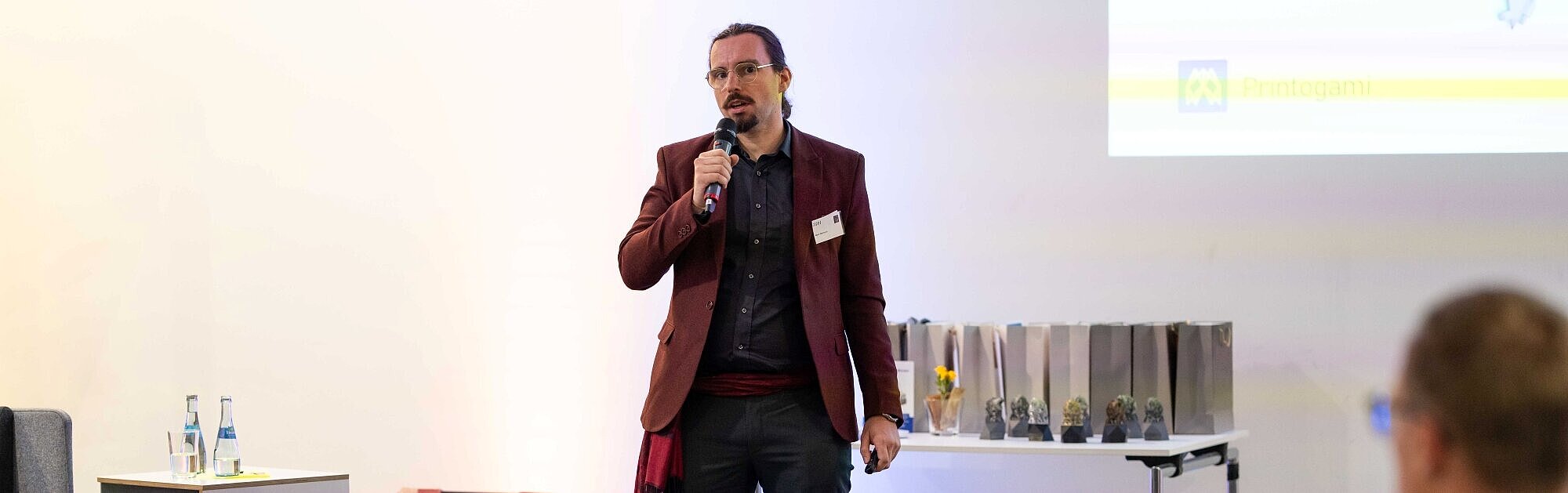
With the "Printogami" approach, these folding techniques are being transferred to additive manufacturing. The result: 3D-printed, foldable structures that combine design, function and production logic. The innovative power of this concept was recently confirmed: Mario Marinovic from BluePrint3D (Regensburg) reached the final of the German 3D Printing Challenge in Neu-Ulm with Printogami:
The aim of Printogami is to detach the origami mechanism from paper and make it accessible as a printable structure for technical applications. The result is a new category of objects - somewhere between movable design piece, functional component and "deployable structure".
Origami as an engineering tool: from folding line to function
Technical origami offers an elegant solution to a central problem in engineering: saving space in large-scale structures. The logic behind it: Large → Compact → Reliably unfoldable.
Repetitive folding patterns in particular, such as Miura-Ori, enable easily controllable, linked movement. At the same time, origami has established itself as a design principle: symmetrical structures create a high aesthetic impact - ideal for applications in which the shape must not only be functional but also visually appealing.
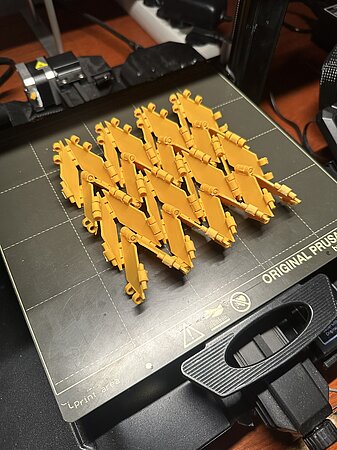
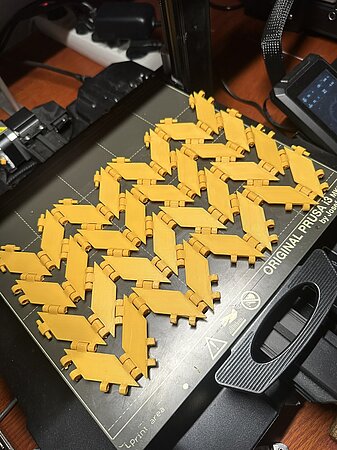
Maximum space saving through geometry: the object in its compact transport state (left) and fully unfolded (right).
Bridging the gap: why 3D printing is predestined for origami
Paper quickly reaches its limits in terms of resilience and system integration. Additive manufacturing, on the other hand, makes this possible:
- Material diversity & durability: robust thermoplastics or elastomers for continuous use.
- Geometric precision: Exact implementation of complex folding kinematics.
- Functional integration: Direct planning of fixing points or mechanical connections.
- Suitability for series production: Fast scaling of size and pattern variants.
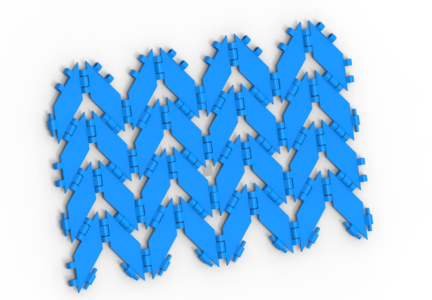
Printogami in practice: geometry replaces assemblies
A core aspect of Printogami is the "kinematics from the printer": the structures are functional immediately after the printing process - without the time-consuming assembly of joints or hinges. Geometry replaces the assembly.
- This opens up new scope for product design and small series in particular:
- Ready-to-use: ready-to-use objects instead of multi-part assembly sets.
- Agility: Extremely short iteration cycles from design to functional prototype.
- Cost-effectiveness: Reduction of component complexity in the FDM process lowers process costs.
BluePrint3D: Engineering for the production of tomorrow
Behind Printogami is BluePrint3D - a young engineering office from Regensburg that focuses on specialized 3D printing solutions. We understand additive manufacturing not as pure prototyping, but as a tool for highly functional end components. Through the symbiosis of engineering knowledge and intelligent geometry, we redefine the limits of what is possible.
Outlook: From idea to product logic While research provides the theoretical building blocks, the task of BluePrint3D is to transfer them into scalable products. The method becomes the application logic: Which pattern offers the optimum benefit for handling, protection or appearance? In the end, the user only has to do one thing: unfold.
Mario Marinovic - BluePrint3D (Regensburg)
Project: Printogami (Origami × 3D printing)
Contact: print(at)bp3d.de - www.bp3d.de - BluePrint3D