Accessibility

 Language
Blockchain for mobility
There is hardly a day without press reports about blockchain technology. Sometimes it's a gleeful report about the crash of a cryptocurrency, sometimes blockchain is highly praised as the salvation of privacy on the Internet. Somewhere between "we always knew this would come to nothing" to "Blockchain will save us the Internet" lies the real truth: Blockchain is an interesting technology that opens up exciting areas of application, but deserves neither hype nor demonization.
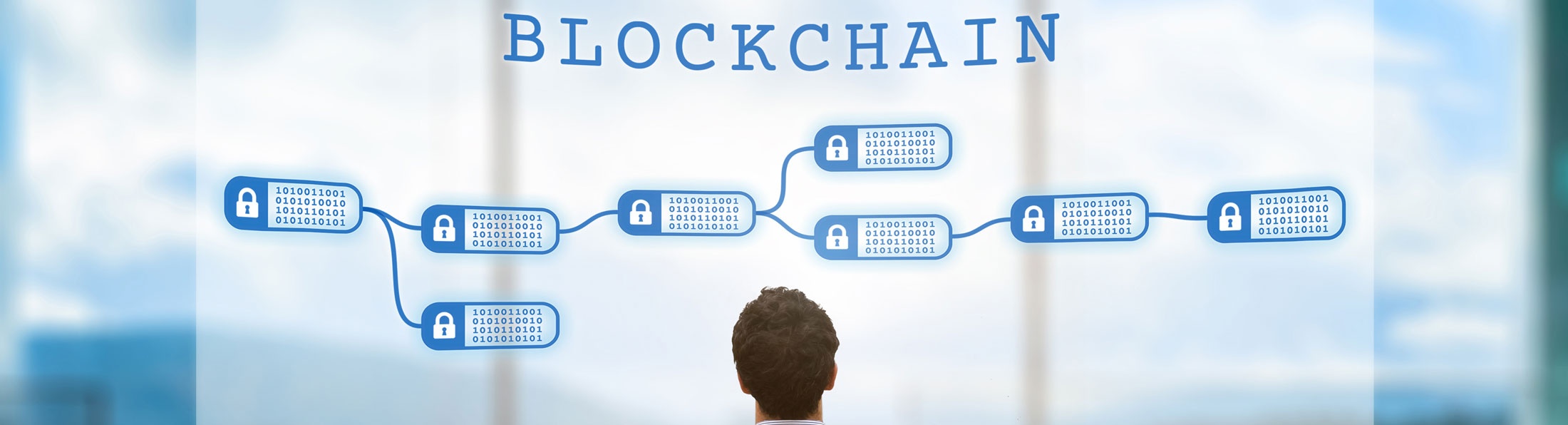 Neither a curse nor a blessing! If you want to use blockchain applications, there are a few points to keep in mind. (Photo credit: iStock@NicoElNino)
What is Blockchain?
What is Blockchain anyway? And why is it of interest in the automotive and mobility sectors?
Blockchain is a form of data storage and therefore basically a database. The data stored in it is divided into blocks, which in turn are linked together in a series (the "chain"). This is the origin of the name "blockchain": a chain of blocks. 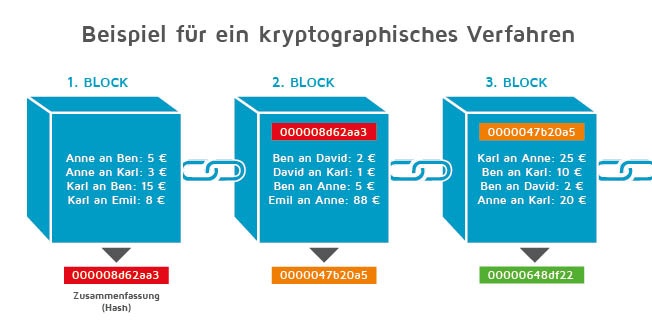 Schematic example of a cryptographic procedure (image credit: Bayern Innovativ) Cryptographic procedures from IT security ensure that once blocks have been written, they cannot be changed. The data in a block are summarized by a so-called "hash function". In this process, the summary of a block is copied to the beginning of the following block, making it part of the data content of the following block. If the following block is summarized afterwards, also the first block is included in the result and so on.
If someone should try to change or falsify the data in a block afterwards, the summary of the hash function of the block will get a different value than the one which is already written in the following block. Therefore, one would also have to change the following block to copy its "wrong" summary into it and then create a new summary of the following block. One would have to virtually adjust and rewrite all the blocks in the entire chain. Here comes distribution, a second important aspect of blockchain.
Most databases and applications today are managed "centrally." Blockchain applications, on the other hand, are distributed: Data and applications are distributed in a decentralized manner across multiple computers that have sole authority over the data. Once data is distributed across multiple computers or organizations, there is a risk that the different copies of the data will have different versions or data states. To avoid this, a "consensus" process runs between all participants in the system to decide which of several data states is the "correct" one. Very simplified, the procedure can be thought of as an election, as each participant votes for one data state. The data state that wins the most votes is accepted as the truth (™) by all.
If someone tries to falsify data, they not only have to completely recalculate their version of the chain, but also manipulate the consensus process to win the majority of votes for their new data state.
What blockchain applications are useful?
The first generation of blockchain applications are "cryptocurrencies," with Bitcoin being the most prominent example. In a blockchain, financial transactions, such as money transfers, are logged. In addition to financial transactions, you can actually store all goods that can be digitized in some way in a blockchain. Examples include land registry entries that store the transfer of ownership as transactions in a blockchain or the seamless logging of the supply chain from the farm to the shopping cart.
Six blockchain applications in mobility
1. Payment systems for autonomous cars
As in other industries, the focus in the automotive sector is on financial applications. If digital transfers are automated, cars will be able to pay for services such as parking or recharging themselves in the future.
2. Parking
As a pilot project, trive.me, a subsidiary brand of EDAG Engineering GmbH, is developing a machine-to-machine payment system for parking spaces that automatically calculates and pays parking fees incurred. At the Bayern Innovativ event "IOTA for Automotive" in October 2018, the trive.me team presented their concept and found more partners for a joint expansion during this event.
3. Platooning
Platooning allows multiple vehicles, primarily trucks, to drive as a semi-autonomous group. The first truck drives and all others automatically follow at close intervals. With a blockchain-based payment system, the following trucks could automatically transfer a portion of their fuel savings to the leading truck as a contribution to slipstream driving. Automatic payment for other services, such as electric vehicle charging, customs fees, or insurance, are in testing or pilot phases.
4. Platforms
As the added value of such payment systems for drivers increases the more different services they can be used to pay for, platforms with multiple service providers will develop and act as intermediaries between providers and customers. A very good example of such a platform is the company ZF Car eWallet GmbH, a spin-off of ZF Friedrichshafen AG. ZF Car eWallet is developing a blockchain-based transaction network that integrates mobility services, vehicles and infrastructure on a common platform. The ZF Car eWallet will be presented in June 2019 at the Bayern Innovativ Forum EcoSystem Highly Automated Driving (EcoSysHAF) presented.
5. Digital Twins
A "digital twin" is a digital representation of a real object, such as a car. The twin describes properties and behavior of the real object. Simulations or analyses with the twin are very popular in production (keyword: Industry 4.0). Additionally, one could use a digital twin to log ownership, repair history and mileage of a real car.
6. Over The Air Updates
It is precisely the immutability of the blockchain that is interesting for OTA (Over The Air) software updates. It gives OEMs the opportunity to check software packages for originality directly before installation. In addition, logging all software updates can prove which software version was installed at which time.
Blockchain projects in a reality check
Although there are several interesting scenarios, blockchain is not necessarily the optimal solution to all problems. Despite the hype around blockchain as the "eierlegende Wollmilchsau", many applications are better served with existing IT solutions, such as SQL databases and web user interfaces.
There are now a great many failed blockchain pilot projects that are damaging the technology's reputation. A study by Boston Consulting Group and Cisco ( reference ) showed that less than 25% of blockchain projects manage to complete the proof-of-concept phase. The Gartner 2019 CIO survey found that only 5% of CIOs see blockchain as disruptive to their business ( reference ). It should therefore be well considered whether blockchain is really a suitable solution.
Blockchain fits best when:
- one only wants to test and gain experience without having to solve a concrete problem optimally.
- the database is shared by many more actors and several actors need to write directly to the database.
- there is no or little mutual trust between the actors.
- there is no trusted intermediary/broker.
- an independent platform without intermediaries is desired.
- a completely decentralized solution is aspired.
These are not exclusively technical requirements. It would also be possible that several companies want a common database, but none wants to take sole responsibility for its operation and maintenance. In this case, a common blockchain database could be built that they maintain together.
How secure is the blockchain?
The security of the blockchain is based on two fundamental aspects that only together ensure its security:
- Cryptographic methods can be classified as "secure" today. However, the future will bring new computing power that cryptography will not be able to keep up with. Quantum computers in particular pose a major threat.
- Successful criminal attacks against the consensus process prove that it is possible to manipulate a blockchain after all ( reference ).
Blockchain: Advantages vs. Disadvantages
Like any technology, the blockchain has advantages and disadvantages that must be weighed. It is definitely worth starting simple projects to gain experience and build in-house knowledge. Before doing so, one should consider: How much trust do you have in your business partner? Is there a central entity that can act as a trusted middleman?
- Is there an existing technology that better meets the requirements?
- Who are the customers: Humans? Machines? Cars?
- Who has control over the services for this "customer"?
- Find a business case or new business model that can take full advantage of Blockchain?
- Does your company culture have the patience to wait a very long time for ROI?
If you find a business case that Blockchain is a good fit for, get started! If not, keep the topic in mind for the future.