Accessibility

 Language
Berlin battery start-up receives 15 million euros
Revolution in battery technology: Theion relies on sustainable sulphur chemistry
27.03.2025
Source: E & M powernews
Battery company Theion receives 15 million euros from investors to further develop its crystal sulphur technology as a more efficient alternative to lithium-ion batteries.
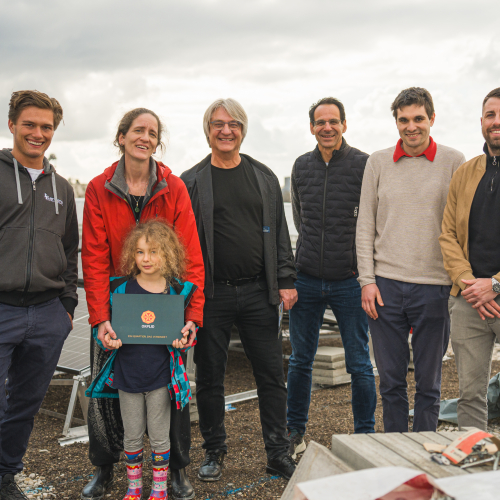
With fresh capital of 15 million euros, the company Theion wants to further advance its innovative crystal sulphur battery technology. The start-up has completed a Series A financing round - the first institutional capital raising to scale the company - and plans to invest the funds in research, development and scaling its cell chemistry.
The aim is to create a more sustainable, efficient and cost-effective alternative to existing lithium-ion cells. Theion sees its technology as the key to progress in aviation, the automotive industry and stationary energy storage.
The financing round is led by the investment company Team Global. Other investors include the solar company Enpal from Berlin and Geschwister Oetker Beteiligungen, an investment company owned by the Oetker family of entrepreneurs. All three investors see great market potential in Theion's sulphur chemistry - both for sustainable electrification and for strengthening European technology locations.
Sulphur instead of cobalt and nickel
For its batteries, Theion uses sulphur - a waste product that it claims is available in large quantities - to replace critical materials such as nickel and cobalt. The technology is based on patented processing of the special crystal structure of sulphur.
Theion aims to solve several problems of current battery systems at once: In addition to the better availability of raw materials, the company highlights the lower weight, lower manufacturing costs and a better environmental balance. According to Theion, the sulphur batteries should be up to three times lighter and at the same time cost a third of the price of current lithium-ion batteries. A key technical problem with sulphur batteries to date has been their low cycle stability. Theion's solution: a production process that should significantly increase the service life and enable more than 1,000 charging cycles - a threshold that is necessary for economical operation. According to the company, the energy density of its cells is significantly higher than that of conventional systems.
Great potential in the aviation and energy storage market
"We believe that this cell chemistry can revolutionize electrification in mobility and stationary applications," says Lukasz Gadowski, founder of Team Global. He sees great potential for aviation applications and the energy storage market in particular. Henning Rath, Managing Director of the Berlin-based PV company Enpal, also emphasizes that Europe needs its own battery technologies in order to become independent of Asian supply chains. Theion could play a key role here.
The Oetker family's investment company also points to the goal of reducing dependence on critical raw materials. According to Sven Wiszniewski, who is responsible for venture capital, the use of sulphur makes it possible to combine performance and sustainability.
Focus on export potential and industrial applications
Theion anticipates growing export potential for sulphur batteries. The company refers to forecasts according to which the global battery market will triple by 2030. According to its own analyses, the annual market volume could rise to around 500 billion euros - spread across the areas of e-mobility, stationary storage and aviation. According to Gerhard Cromme, Chairman of the Supervisory Board of Theion, the company wants to enable Europe to make its own contribution to the global battery market with a technology that is independent of imported raw materials.
The company emphasizes its own development approach, which differs from capital-intensive strategies in the USA. Instead of large teams and high material input, Theion relies on small, specialized development units with a strong scientific focus.
Author: Davina Spohn