 Accessibility

 Language
08.05.2023
#bayernkreativPORTRAIT: We had the pleasure of talking to cellist and Head of Business Development and Product Manager of various start-ups in the music and technology industry Ivan Turkalj about his work and the flourishing intersection of music and technology. Ivan sees his various roles as an opportunity to gain new experiences and broaden his horizons - an attitude he considers essential for the creation of innovations. Also with the support of technological developments such as AI. But he is certain that people will always be the decisive factor here. Find out more about Ivan and what he always has to say with a pinch of humor here.
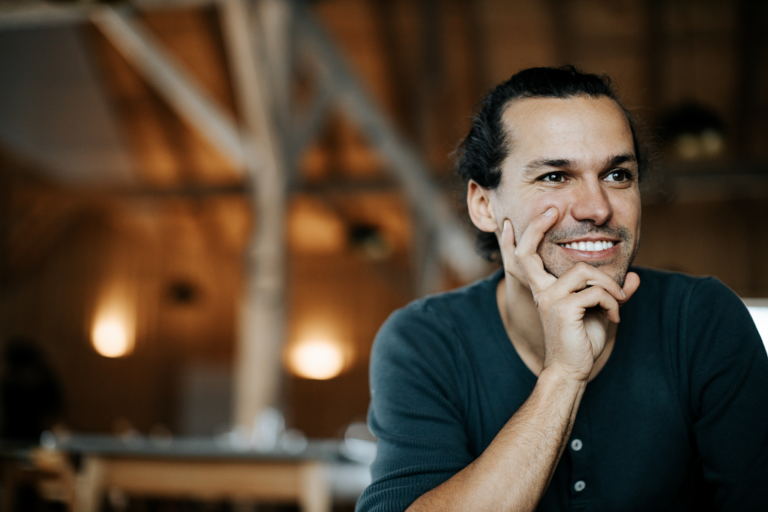
Dear Ivan, you are a successful cellist, play in various bands and run your own music label. At the same time, you work as Head of Business Development and Product Manager in various start-ups in the music and technology industry. Which title do you feel more comfortable with: musician or entrepreneur?
Depending on what is needed at the time. Musician on stage. Entrepreneur backstage and at the computer. The most important aspect of my various activities is that they all cross-fertilize each other. As a product manager, you learn about new technologies, which you can then use artistically for different purposes. Running a music label also means making sure you have new 'stuff' to release. As a musician, I always try to get to know new styles, musical directions and people. So I try to keep my horizons broad and learn from other experts.
Recently, three of your pieces, including Chopatti, which you (re)composed, can be found in the ARD Mediathek (ARD Klassik: Turkalj - Chopatti - Ivan Turkalj - BR-KLASSIK | ARD Mediathek). How do you approach composing your own piece, what inspires you?
Composing is actually confined to my study and I see it as an exercise to better understand other composers and their choices. My good fortune is that I am surrounded by colleagues who can compose excellent pieces. Chopatti was born out of a need to write an exercise for a technique called "chopping". I took an old etude by Alfredo Piatti and altered it a little. Somehow the piece managed to escape from my study...
Together with Florian Willleitner, you founded the international collective "Pool of Invention". This collective allows creative minds from different fields and cultural backgrounds to create something together. Your motto is "1+1=3". What makes your projects greater than the sum of their parts?
There is great power in approaching each other with an open mind and creating something new from two sets of experiences. This is often something unusual and unfamiliar, which may take some time to get used to and develop a common language - standing still is not an option. Usually, a strong artistic idea is the nucleus from which everything starts. Depending on which area you come from, the perspective on this nucleus or approach is different. This is where an exciting process begins that creates a new thing from two individual building blocks.
That's why 1+1=3.
Innovation plays a major role in your artistic work. How do you relate to classicism and tradition in your work?
I love history as a natural science and encyclopaedia from which you can learn a lot. The same goes for art and music. In its time, today's "classical music" was contemporary or revolutionary. Listening habits and musical language have changed, so we have a different vocabulary today than we did 100 or 300 years ago. This raises the question for me: what can I take from tradition and transfer to the present? That is an exciting puzzle for me. Or to put it another way: I love talking to old and experienced people in order to learn from them. They are an inexhaustible resource of ideas, just like children. That's why the tension between innovation and tradition is extremely exciting for me.
Is my innovation just a contemporary form of existing inventions and ideas? Where does the urge to believe that I have to reinvent everything come from? Is the old "boring" and if so, why? Or to put it another way: unfortunately, we too often forget that we are not the first people on this planet.
You are not only a soloist, but also have great international success with the ensemble "The Erlkings". This ensemble is also innovative: you play classical pieces, e.g. by Beethoven or Schubert, with guitar, tuba, cello and percussion (live from Studio 2 of the Munich Funkhaus: BR-KLASSIK-Studiokonzert | Radio | BR-KLASSIK | Bayerischer Rundfunk) and sing the lyrics in English. How did you come up with this combination and how does your audience react to it?
I like to say: The Erlkings shouldn't actually work. The combination of instruments alone is outrageous, let alone trying to perform the sacred songs of Schubert, Goethe and Schiller in English and as a band so faithfully to the original. But the same applies here: we do it out of love for the repertoire, without compromise, with a claim to originality (deliberately meant ambiguously) and with a great desire to bring these songs closer to the people. The balancing act of convincing the professional audience and the "newcomer" at the same time is an important goal.
An anecdote from the Wigmore Hall in London, one of the conservative song centers that need to be convinced: After the concert, a very, very excited listener came backstage and said he hated what we were doing with his Schubert and the songs. He has very specific things/emotions/parameters that he expects and feeds off, and our way of doing things is completely against his convictions. And yet he got everything he expected at our concert. By far one of the best compliments I can remember.
You are interested in both music and technology. Recently, AI systems that are also relevant to the art, culture and creative industries have been making headlines with their capabilities. Dall-E-2, for example, generates images in any artistic style, while ChatGPT can produce all kinds of texts, from screenplays to novels. How do you see the relationship between art and technology?
I always find it interesting to play around with new technologies and see when and how you reach their limit. The progress in this area in recent years has been enormous, but an AI without a good pool of information won't get very far either. That's why I still see a 'fair' cooperation here. At best, we will learn to use these technologies as an instrument or stylistic device. It's still too early for the doomsday mood and fear. (ah, if only I had done the interview with ChatGPT, I might have saved a lot of time...) ;-)
Will computers be better musicians one day?
No, I don't think so. Because human interaction is also part of the musical experience. Will they be able to produce "better" music for certain products or occasions? Certainly, if they are fed with good data. But good music needs that certain something and not just the right algorithms and expectations. A positive example: I can very well imagine that music in the elevator or telephone hotlines of airlines or Deutsche Bahn will become more varied if
we let an AI do it.
When you think about the future, how do you think we will produce and perceive art?
What I hope for, admittedly very romantically, is that art becomes more of a general hobby again. Creating art yourself is even better than just consuming it.
Ivan, you are also internationally active. You live in Vienna, but also work in Germany, for example, especially in the border region between Bavaria and Bohemia, and you co-founded the international collective "Pool of Invention". How does internationalization affect your work?
To be honest, I don't know any other way and it's a matter of course for me as a musician. I've been traveling internationally with the cello since I was twenty and the only break was during the corona lockdowns.
My intensive years with the Canadian band "The Hidden Cameras" shaped me. It was a colorful bunch of artists and musicians from the USA, Canada, England, Austria and Germany. During the many five to six-week tours, I really experienced for the first time what internationalization means, what differences can be felt through cultural identity and how much you can learn and take away from each other. Border areas in particular are an exciting topic.
The Bavarian cultural and creative industries are vital, cooperative, polyphonic and relevant to the future. We introduce you to Bavarian players. What is their business model? What drives them?
Would you also like to answer a few questions and be part of our "bayernkreativPORTRAIT" campaign? Then send us an email to kontakt(at)bayern-kreativ.de with the keyword "bayernkreativPORTRAIT".