 Accessibility

 Language
08.08.2022
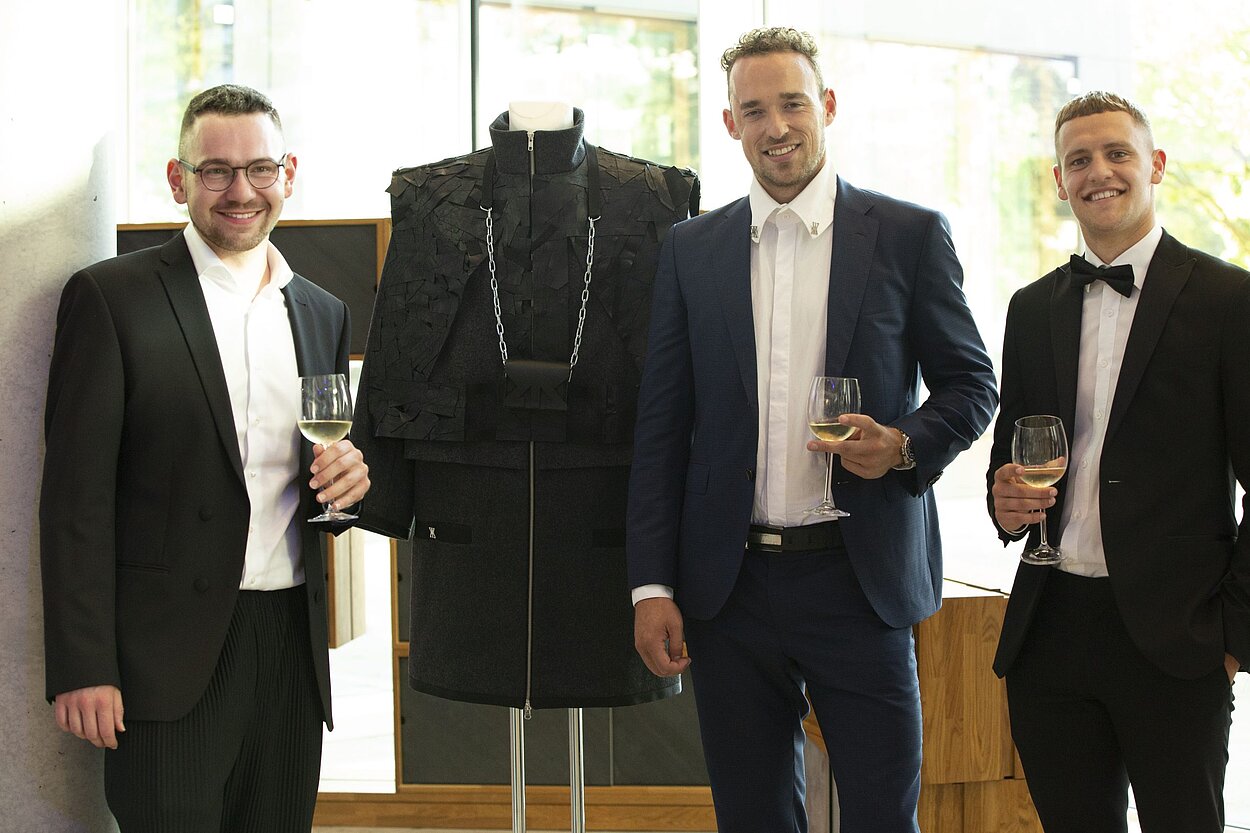
#bayernkreativPORTRAIT: Bespoke tailor Felix Flechtner and his colleagues Sebastian and Florian win this year's Central Franconian Crafts Design Award with a three-layer wool coat and mini bag. We talk to Felix (among other things) about the award, what his profession has to do with sustainability, what future prospects are opening up for bespoke tailors and what influence the music genres techno and classical have on the design of the garments from the fashion brand NCHTFLTR.
Congratulations to the three of you on your award!
Thank you very much! It was a great honor for all three of us to be one of the six winners of this year's Design Award of the Middle Franconian Crafts. We only came across the competition by chance at the end of January and were thinking about what we could submit. At the time, we were working on a minibag and our creative mind in the group, Sebastian, immediately drew up a sketch for the coat, which - according to the idea at the time - was to be inspired by the minibag. I then implemented the idea at the tailor's table. The fact that our young start-up "NCHTFLTR" then went on to win an award makes this project unforgettable for us.
The idea of sustainability is extremely important to you. Was the idea of more sustainability already shaped during your training as a tailor and if so, why?
Yes, absolutely. As a tailor, your training gives you a completely different relationship to garments and their value anyway. Sustainability is a daily topic in all ateliers, it's just not communicated enough because most people take it for granted. This means that even the job of a tailor is extremely sustainable. The garments are made exactly according to the customer's wishes and usually only once. When selecting materials, care is taken to use high-quality fabrics. The highest standards are set for the workmanship. This guarantees the longevity of a piece. In contrast to the textile industry, which is one of the biggest polluters of the environment, a tailor produces virtually no waste. We do not destroy "over-produced" garments and do not use chemicals or dyes that pollute the water.
The motto of your fashion brand NCHTFLTR is "Dare to be different". The design style is primarily based on the subculture of the techno rave scene. To what extent has this subculture become an inspiration for your philosophy?
This idea came about - like so many others - during one of our creative weekends, which were held in abundance during the lockdowns. We originally wanted to call our first collection "Butterfly". Flo and Sebastian had already founded the brand "Flick&Kaxx" with the philosophy and idea of dedicating each collection to a different animal. The result was not just a collection, but a second brand called NCHTFLTR. The inspiration from the techno scene came from Sebastian's and Flo's personal interest in this music genre. I was initially rather critical of the genre, but that has since changed. However, our garments are not only inspired by the techno scene, but always incorporate an elegant style element. I bring this style element, inspired by the classic genre, into the brand. The garments can also be worn to the opera. It is precisely this combination that makes us and our design style unique. It is important to us that we differentiate ourselves from the classic techno brands.
You produce 100% Made in Germany. Your materials are selected sustainable, sometimes even vegan textiles (e.g. cactus leather). To what extent do you think a company like Flick and Kaxx with the fashion brand NCHTFLTR can contribute to a change in mentality among customers that leads away from cheap fast fashion and towards more sophisticated, higher-priced fashion? And how does your location focus on Germany play a role in this?
We thought long and hard about this topic and ultimately wrote the change in mentality mentioned above as an overriding goal on our banner. We thought about it: How can we convey to our younger generation what high-quality and fairly produced clothing means? How can this generation continue to consume sustainable clothing in the future? To this end, we have built up a network of tailors who support us in the production of a collection. For a fair wage, of course. Every tailor receives a work package from us, with a plan and a sample of how the pieces are to be sewn. They can then simply sew the remaining pieces on site. Each tailor receives a maximum of ten pieces to be produced. This means that we deliberately set different standards in terms of quantity than an industrial company. And customers receive a rare and high-quality item of clothing. All our partners are based in Germany. This means we can also guarantee short, sustainable production routes. It will take decades for everyone to change their way of thinking. But it is important that someone starts and we think our idea has great potential.
The "Deutsche Handwerks Zeitung" quotes you in an article from August 2021 that your fashion brand NCHTFLTR wants to show new ways for bespoke tailors. What new paths are these? And how do you provide them?
The question goes hand in hand with the topic of "bespoke tailoring and the future". Most people always have the image in their heads of the little tailor sitting in his little room and sewing away in solitude. Or they ask themselves whether there are any tailors left at all. The answer, quite clearly: YES! In fact, the profession has far more potential than some people think. You just have to be open to new approaches. For example, organizing yourself in the aforementioned tailor network. In theory, this network can be expanded indefinitely, making "Handmade in Germany" possible. This may sound like mass production again, but the work is still very handcrafted. Gaps in orders can be filled by orders from the network. To pick up on the idea of sustainability again, we are also constantly developing new methods and ways to produce zero waste. For example, we recycle all our waste in an annual ZeroWaste collection, which only produces unique items and thus reinforces the trend towards more individuality.
How important is an individual development process for you when creating new fashion and how does the fashion brand NCHTFLTR generate this individual development through its design for your bespoke tailors?
Very important. Ultimately, bespoke tailoring is a form of art. Of course we always create wearable styles - at least until now. Nevertheless, we make a very clear statement with our philosophy behind it. Our creative direction provides us with the framework. In addition to sustainability, important points include various design elements (e.g.: Contouring, layering look as with our coat, use of certain ingredients such as webbing, buckles or our rivets) and the gender shift, or unisex idea. We clearly say: "Be yourself; wear what you feel comfortable in and break social conventions and norms." For our tailors, sewing with ever new materials and cuts is particularly interesting and varied. Of course, they have no influence on the design itself, but they still benefit from the collaboration. For example, they can pick up new ideas when working on our pieces, use them for themselves and implement them creatively.
The Bavarian cultural and creative industries are vital. Cooperative. Polyphonic. And relevant to the future. We introduce you to Bavarian players. What is their business model? What drives them?
Would you also like to answer a few questions and be part of our "bayernkreativPORTRAIT" campaign? Then send us an email to kontakt(at)bayern-kreativ.de with the keyword "bayernkreativPORTRAIT".