 Accessibility

 Language
21.12.2022
#bayernkreativPORTRAIT: We spoke to filmmaker Erec Brehmer about his film "Who We Will Have Been"; a poignant documentary about the loss of a loved one. A film about grief - but also about affection, love and appreciation. With his subjective, personal narrative style, Erec guides the viewer through his shared story with Angi.
In our interview, Erec tells us, among other things, what prompted him to make the film and its release, how the "Young Art and New Paths" scholarship program was able to open the doors of cinemas to him and what lies behind the title "Who We Will Have Been".
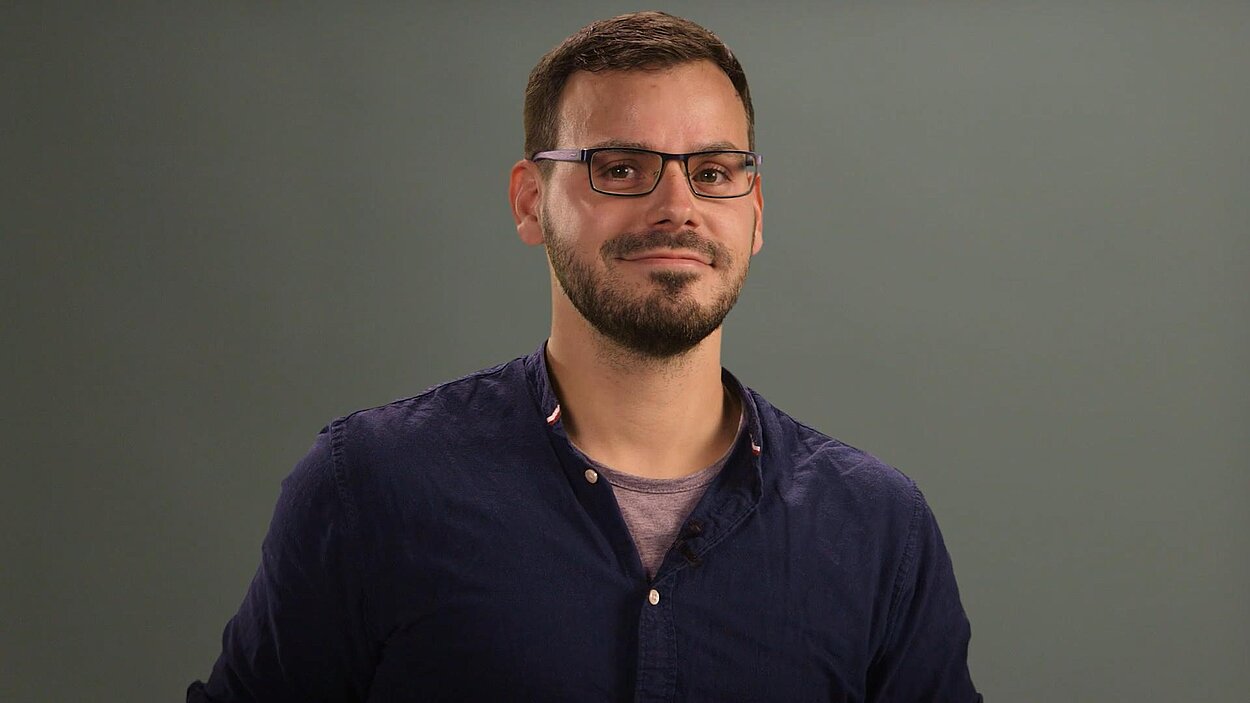
Dear Erec, your movie "Who we will have been" is poignant, emotional and touching. A documentary and a story about the loss of a loved one. Why did you make a movie out of this personal event?
As a filmmaker, I deal with the things that bother me in a cinematic way, of course, and after Angi's death I couldn't think about anything else: How can I wake up from this nightmare? When will the pain stop and who can I even be now? How can I keep Angi in my life when I will never stop loving her? Since I shot an incredible amount of Angi and myself during her lifetime and tried out every new technique on her, I had this amount of image material. So I started to look through old photos and videos of Angi and put them together into little sequences. That was all the access I could still have to her. It was the only way to see and hear her again and to rediscover her through the material. And over time, I also started documenting my grief, simply because I realized that there were great inhibitions in my circle of acquaintances to deal with the subject and with me. Over time, I made a movie in which I tried to find out where Angi could still be present in my everyday life, because I still love her and never want to "let go". And I made a movie about grief, just as I would have needed it back then in the hospital when I asked myself: How does that work, grieving?
Your film consists exclusively of private footage. Why did you decide on this style of realization?
For one thing, I had all these countless shots and I never intended to create a movie for the big screen to begin with. Initially, the project was a very private one. It was only over time that a story emerged that many people encouraged me to show, as it could also be relevant for other people. Nevertheless, I never wanted to shoot additional material, other images or interviews for the film. I felt that the amateur footage of me had a special authenticity and closeness that could never be staged. And even that newly shot images could weaken the amateur shots. At the same time, I knew that I could never tell absolutely who Angi was. I could only tell who Angi was to me. How she shaped my world. And that's why I opted for the most subjective, personal and least artificial way of telling the story. That was the most honest approach for me. Over time, I naturally developed a certain ambition as a filmmaker: is it possible to tell a consistent feature film solely from the pictures we take with our cell phones every day, from chat messages and internet traces?
It's not just the image, but also the sound in its various facets (voiceover, noises, music) that makes the film so emotional - why was that so important to you?
That's the beauty of the medium of film, that so many levels - image, sound, music, editing - can interact and complement or contradict each other. I really like it when questions are raised on the sound level that run counter to the visual level and thus generate questions in the viewer: What is happening? Where is this taking me? Why don't I trust the images right now? Allowing contradictions and finding an honest way of expressing something that is difficult to express was one of the challenges of the film. And of course the narrative, the questions, the voice over, holds the film together and gives it structure. Above all, it was important for me to ask questions and search the images for answers, even if I never get answers to some questions. But asking questions can be very valuable in itself.
You get stuck on the title of the movie and feel that this is something very special. How did you come up with the title?
The title is based on a quote from Roger Willemsen, whose work Angi and I have always enjoyed listening to. In his "Future Speech", his last published manuscript, he dealt with the perspective of the present, among other things. He wrote there that in order to understand ourselves in the here and now, we must not ask who we were and how we were able to become who we are now, but that we must look at ourselves from the perspective of the future. We should therefore ask ourselves who we will have been in order to adapt ourselves and our actions in the present. For me, this was a nice starting point and subject of investigation for the film: the question of who Angi and I will have been when I am old. And what that means for my understanding of the present. What kind of relationship will we have had now that we still love each other, but she is no longer there. And who can I still be now, and what will my life and Angi's life have meant in the future.
Your film was supported as part of the Free State of Bavaria's "Young Art and New Paths" scholarship program. Tell us, how did that work?
I heard about the scholarship program early on, but because it was labeled so much as Corona aid for young artists, I always thought I was still doing too well to even apply. The documentary then screened successfully at festivals and I started looking for a distributor. I kept hearing from many interested distributors: "We have to wait. Corona means we don't know how the cinema landscape will develop. We can't support any more small films right now." But since it was important to me to release the film - because what good is a film if no one can see it - I thought about releasing it in cinemas myself, even though I had no experience with it. With this in mind, I applied for the grant program and when I got it, that was the decisive reason for releasing the film myself. In the meantime, it has reached almost 5,000 viewers and was shown for many weeks in over 85 cinemas. It has been released on DVD, has brought comfort to many mourners and has also been licensed by the Catholic Film Society for educational purposes. The media response was enormous, there were only positive reviews and as all profits from the film are donated, I have already been able to donate €12,500 to charities. The fact is: without the "Young Art and New Paths" grant, none of this would have happened.
What was the biggest challenge with your film?
I would say there were two big challenges. The first was: How can I tell people about a feeling who have never experienced it themselves? How can I make it tangible what the loss of such a close person can mean, how it changes your own world and how existential and devastating this pain feels? The second challenge was: How can I talk about Angi? How can I do justice to this person in the short time of the film and convey an impression of this beautiful person? Because it was very important to me that the viewer should get to know Angi again through the movie and fall in love with her like I did. As a viewer, you can only understand how much joy and life has disappeared from this world with her death.
Who is the target audience for your movie?
Of course, I hope that everyone can relate to this movie, because it tells the story of how you can go through a deep crisis and emerge as a new person. A topic that we are all familiar with after corona, but also through our individual life stories. During the cinema tour, however, I also noticed that it was primarily older people sitting in the cinema who had already come into contact with the topic of death. Many affected people, staff from hospice associations, but also many young mourners were in the audience. It was exciting to see that each individual was able to find themselves in the movie in their own unique way and was grateful that the topics of death, grief and love were being talked about so openly for once. It didn't matter whether you had lost your partner, your mother or even a child. Grief for a loved one can bring us together. It was only through these encounters that I really realized that there is a lack of real engagement with these issues in the middle of society.
Finally, a very private question: was working on the film your personal way of coping with grief and how are you doing today?
Of course, working on the film helped me to organize and reflect on the events. That was incredibly important, especially in the first year of the editing process, even though it was just as important to change perspective in the second year and no longer make a film for myself, but for other viewers. But of course it helps to have to find words and images for fears and painful feelings. That's how you take control of them. I'm doing very well today. I have reintegrated Angi into my current life as best I can and at the same time started a new one, with a new perspective on many things. And as a filmmaker, I'm already working on new projects, both documentary and fictional.
The Bavarian cultural and creative industries are vital, cooperative, polyphonic and relevant to the future. We introduce you to Bavarian players. What is their business model? What drives them?
Would you also like to answer a few questions and be part of our "bayernkreativPORTRAIT" campaign? Then send us an email to kontakt(at)bayern-kreativ.de with the keyword "bayernkreativPORTRAIT".