 Accessibility

 Language
Beyond Silicon: The Future of Computing
Alternatives to Classical Computing
Beyond the Limits of von Neumann Architectures
Technological progress over the past decades has been driven largely by improvements in classical electronic and computer architectures. These are predominantly based on traditional computational models with a clear separation between memory and processing units, as well as deterministic, sequential execution.
Regardless of the material used, today’s von Neumann architectures are increasingly approaching fundamental efficiency limits: data movement dominates energy consumption, parallelism can only be exploited to a limited extent, and certain classes of problem remain difficult to handle despite increasing computational power. At the same time, requirements are shifting: applications in artificial intelligence, simulation, optimization, sensor data processing, and real-time control demand new forms of parallelism, adaptability, and energy efficiency.
In light of these developments, new computing paradigms are emerging that no longer rely primarily on higher clock frequencies or architectural scaling within classical processor designs, but instead on alternative physical and architectural concepts to address specific tasks more efficiently. In this article, we examine four such paradigms: quantum computing, photonic computing, neuromorphic computing, and biological computing. These represent four fundamentally different, yet equally compelling computing technologies of the future.

Quantum Computing: Computing with Superposition and Entanglement
Quantum computing extends the classical computational model by exploiting quantum-mechanical states. Qubits enable the representation and processing of information in superposed states and allow for entanglement. As a result, certain computations can be performed faster and more efficiently than on classical computers.
The advantage does not apply to general-purpose applications, but to clearly defined problem classes, such as the simulation of quantum systems, selected optimization problems, or specific linear algebra operations. Compared to today’s high-performance computing systems, the benefit lies not in short-term performance gains but in the potentially fundamentally different scaling behavior of certain algorithms. Companies are already engaging with quantum computing in order to identify relevant use cases, develop hybrid classical–quantum approaches, and realistically assess technological maturity.

Photonic Computing: Computing with Light
Photonic computing uses light as an information carrier, particularly for data transmission and linear operations. Photons enable high parallelism and bandwidth with minimal interaction, making them especially suitable for data-intensive tasks. In practice, hybrid systems are often emerging that combine photonic and electronic components.
Compared to electronic architectures, the key advantages lie in high parallelism, low latency, and the energy-efficient implementation of specific mathematical operations. These approaches are particularly relevant for data centers, AI accelerators, and high-speed communication systems. For companies, photonic computing is attractive because it can be integrated step by step into existing systems and is already being used productively today in selected application areas.
Neuromorphic Computing: Inspired by the Brain
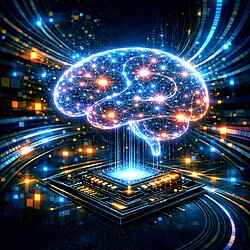
Neuromorphic computing follows an approach inspired by the structure and functional principles of the human brain, modeling neuronal and synaptic processing mechanisms. Information processing is asynchronous and event-based: states are activated only when needed—similar to neurons in the brain—leading to significant energy savings. In neuromorphic systems, data processing and storage are co-located within a common hardware topology, eliminating the need for data transfer between processor and memory and reducing latency.
The added value compared to today’s architectures lies less in general computational performance and more in the ability of neuromorphic systems to flexibly respond to changing inputs without necessarily requiring complete retraining. Neuromorphic systems are particularly suitable for sensor data processing, energy-efficient edge applications, and tasks involving temporal patterns or closed-loop control systems, where systems must continuously react to inputs and adapt their behavior.
Biological Computing: Computing with the Molecular Building Blocks of Life
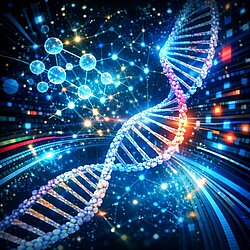
Biological computing encompasses computational approaches that use biological, biochemical, or molecular processes for information processing. These include molecular reaction networks, chemical logic systems, synthetic biological circuits, as well as DNA- and RNA-based methods. Such approaches fundamentally differ from electronic computers, as information is represented and processed not through electrical states but through concentrations, reaction dynamics, and physical and chemical interactions interactions.
The potential advantage of biological computing lies not in high clock frequencies or low latency, but in massive physical parallelism and extremely high information density at the molecular level. Computational operations emerge through many simultaneous reactions rather than sequential instruction execution. Most approaches remain at the research stage today, yet they open long-term perspectives for specific problem classes and novel forms of information processing that are difficult to realize using classical electronic architectures.
Understanding Today, Preparing for Tomorrow: Strategic Implications for Companies
These computing paradigms will not replace today’s systems in the short term. However, they are already influencing research strategies, architectural decisions, and long-term technology roadmaps. Early understanding enables companies to identify realistic application scenarios, assess technological risks, and build expertise before concrete applications reach market maturity.
At a time when classical performance scaling is becoming increasingly challenging, architectural and physical alternatives are gaining importance. Those who understand the fundamentals today will be better equipped to assess future developments and make informed decisions.
These four approaches will take center stage at Beyond Silicon 2026, where quantum, photonic, neuromorphic, and biological computing will be discussed from both technical and strategic perspectives.
A deeper exploration of these four approaches will be offered at Beyond Silicon 2026, where quantum, photonic, neuromorphic, and biological computing will be discussed from both technical and strategic perspectives. Bayern Innovativ provides a platform for meaningful dialogue between industry, research, and innovation leaders — and invites you to be part of it. Join us to explore the future of computing — and prepare your organization for the post-silicon era.