Accessibility

 Language
20.09.2023
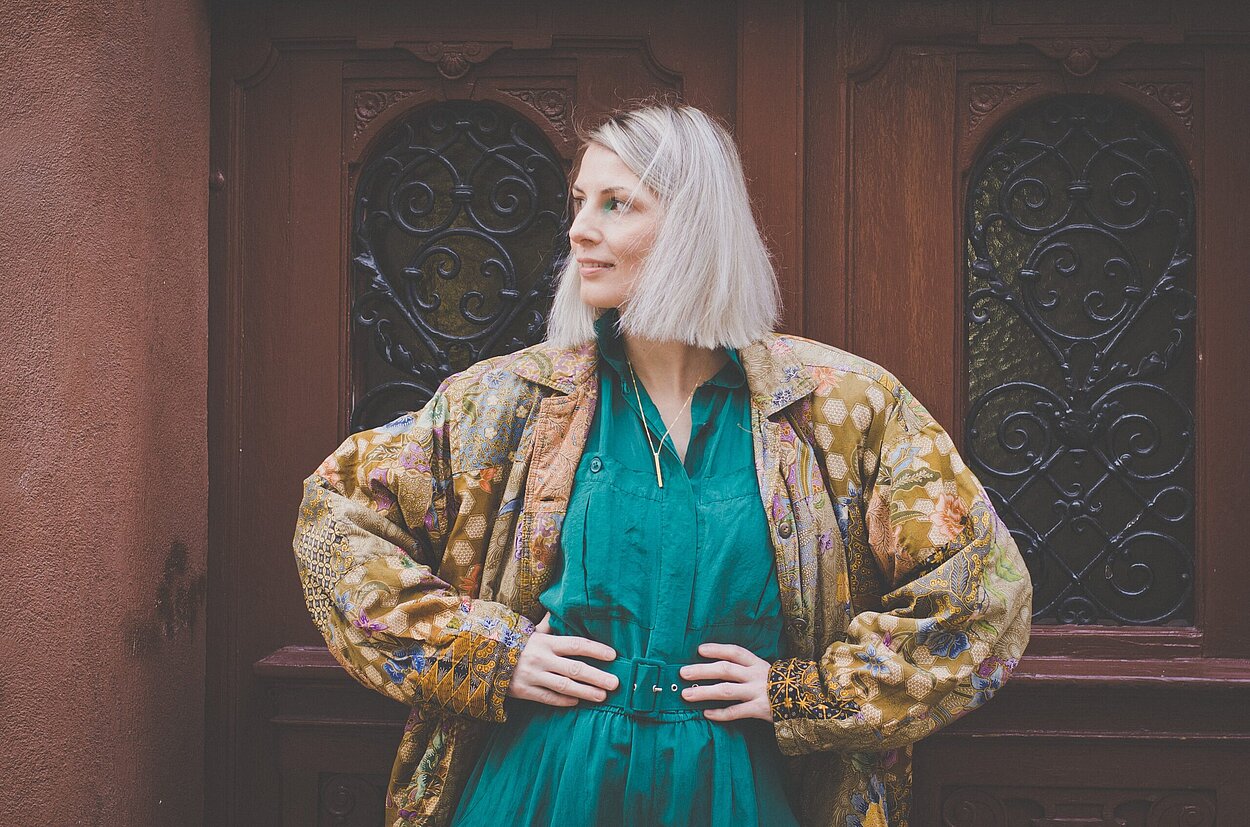
#bayernkreativPORTRAIT: A look into the creative life of Pauline, a writer, presenter and psychologist who creates worlds with words. Discover in our bayernkreativPORTRAIT how Pauline's love of words and language led her down the path of writing, what role psychology plays in her creative work and how she enables people with dementia to experience a new form of memory rehabilitation through poetry. An interview that sheds light on the magic of words and the versatility of creative expression - find out more about Pauline and her plans for the future.
Dear Pauline, you are a writer, presenter, qualified psychologist and much more. Would you like to tell us something about how you got into writing and what fascinates you about this art form?
I have been fascinated by words and language since I was a child. When I was learning to speak, I always asked my parents what a word rhymed with. At school, I devoured everything there was to read. I was a big Three?? fan and read all the books in the library. I was particularly fascinated by Justus Jonas and I really wanted to meet him, without realizing that he was just a fictional character. So I decided to become a detective to get to know Justus Jonas. As I hadn't come across any exciting cases that I could solve myself, I started to make up my own detective stories. Those were the first stories I wrote. And then I just never stopped writing. I always had notebooks with me to record everything. I think I'm just interested in people and I like to observe what's going on around me. That's why I also studied psychology. The combination of both interests is perfect for me. I love my job because it is so varied and because no two weeks are the same. What fascinates me about writing is the sound of language, but also quite simply: the condensation of language in poems - how can I express something big with just a few words and perhaps even move others?
You offer workshops for creative writing and further training for teachers on the subject of poetry slams. How does your training as a psychologist influence your work as a writer and coach?
I simply can't ignore the psychologist in me, and that's a good thing. Of course, I have a different perspective on group and learning processes and can quickly grasp what is going on in a school class and what issues are present. Writing can raise very sensitive issues with people, and in the workshop I have the opportunity to deal with them. For example, I work with refugees, people with disabilities and young people at special schools. It's important to me that everyone can write, and I use different methods to encourage creative ideas in different groups. So I approach workshops pedagogically, psychologically, literarily and artistically. I notice that this combination works well and that teachers also benefit from knowing that I also have a pedagogical view of young people.
How do you organize your writing workshops and what would you like the participants to take away from them?
I design each workshop individually, depending on the composition of the group, topic and age cohort. There are, of course, exercises that I like to use because they work well in all workshops, such as writing pixies. It is important to me that at the end of the workshop, each participant has learned that creative writing is not that difficult and that they have methods of creatively expressing their own thoughts. It's nice when I can accompany people over several years and see how they develop in their writing. Together with my colleague Tobias Heyel, I have been running poetry slam writing workshops for Theater Ingolstadt for over ten years. We have also continued during the pandemic, online via Zoom. We only met some of the young people live after two years. They have since founded a writing group and give each other tips on where they can perform. They also compete in the German-language Poetry SLAM championships, for example, and I accompany them there. For me, there is nothing better than supporting people on their very individual creative writing journey. Participants always have the opportunity to contact me by email, even years later, with questions about texts or for networking.
Together with Prof. Dr. Henrikje Stanze, you have developed your own form of therapy for memory rehabilitation in which people with dementia can recite poems and write them themselves. What experiences have you had with this?
We have had very good experiences with it. We see how people with dementia or other cognitive impairments gain in quality of life. The idea for the project came about when we met Gary Glazner, the American inventor of this concept, over ten years ago. Henrikje Stanze and I then thought about how we could develop it further for the German-speaking market. As society is getting older and older and more and more people are suffering from dementia, we have to address this issue and look for alternatives to drug therapy. In recent years, we have also developed the concept further with other groups under the title "KunstPoesie" (ArtPoetry), for example with people with mental illnesses or disabilities. We regularly work with museums in Bavaria, in particular the DASMAXIMUM museum in Traunreut in the Upper Bavarian district of Traunstein.
In addition to all this, you also regularly host poetry slams throughout southern Germany and, together with Tobias Heyel, you also perform slam poetry on stage yourself as großraumdichten. What do you enjoy more: writing at your desk at home or performing on stage?
I enjoy both equally, and there are always different phases. The phase in which I do more writing and research, and then the phase in which the writing goes on stage. However, I don't earn any money from writing per se, so I always have to coordinate how I create free time for writing. In recent years, I've usually taken August as a creative break. During this time, I gather ideas for texts or find peace and quiet without being on the road all the time. I think about what my next creative projects should be. I have found that traveling is very inspiring for me and provides many ideas for texts. My biggest dream would be to travel and write for a year. But of course, performing on stage is also part of it, and it's what makes my job so enjoyable for me.
In 2021, your second volume of poetry "nach der Illusion" was published by Lektora-Verlag. What themes and motifs inspire your poems?
I'm very interested in how realities are perceived and how different they can be. This can mean, for example, that people simply perceive the world differently due to a mental illness such as dementia, psychosis or depression. Are there two realities in quantum physics that exist side by side, namely that quanta exist simultaneously as a wave and as a part? That kind of thing fascinates me. And then, of course, there is the passion to be deliberately deceived, for example at a magic show, and to be confronted with a fake reality that you know doesn't even exist. In the poetry collection, I also consciously made sure that the use of lower case and line breaks created different ways of reading the poems, i.e. different realities. Basically, everything I perceive around me inspires me. Sometimes I experience a situation that really fascinates me and I write new texts about it for weeks on end. Sometimes there's a topic that makes me say, okay, you should actually write something about that, and here too I'm currently exploring the intersection of psychology and literature.
What projects do you have planned for the future?
Right now, I'm working intensively on the question of the extent to which artificial intelligence and creative expression can harmonize with each other. I'm working on a project with AI expert Michael Katzelberger in which I enter into a lyrical dialog with an AI. I also work closely with the sound artist Burkard Schmidl, with whom I have developed an interactive lyrical sound installation. We exhibited this last year at the Heinz Nixdorf Museumsforum as part of the "Poetry in digital spaces" exhibition. I've also had an idea for a novel for years that I'd like to continue working on. I would like to have a few months at a time to write it in peace. Maybe I could get a grant for it. And I also already have an idea for another volume of poetry. Fortunately, I haven't run out of ideas yet.
The Bavarian cultural and creative industries are vital, cooperative, polyphonic and relevant to the future. We introduce you to Bavarian players. What is their business model? What drives them?
Would you also like to answer a few questions and be part of our "bayernkreativPORTRAIT" campaign? Then send us an email to kontakt(at)bayern-kreativ.de with the keyword "bayernkreativPORTRAIT".