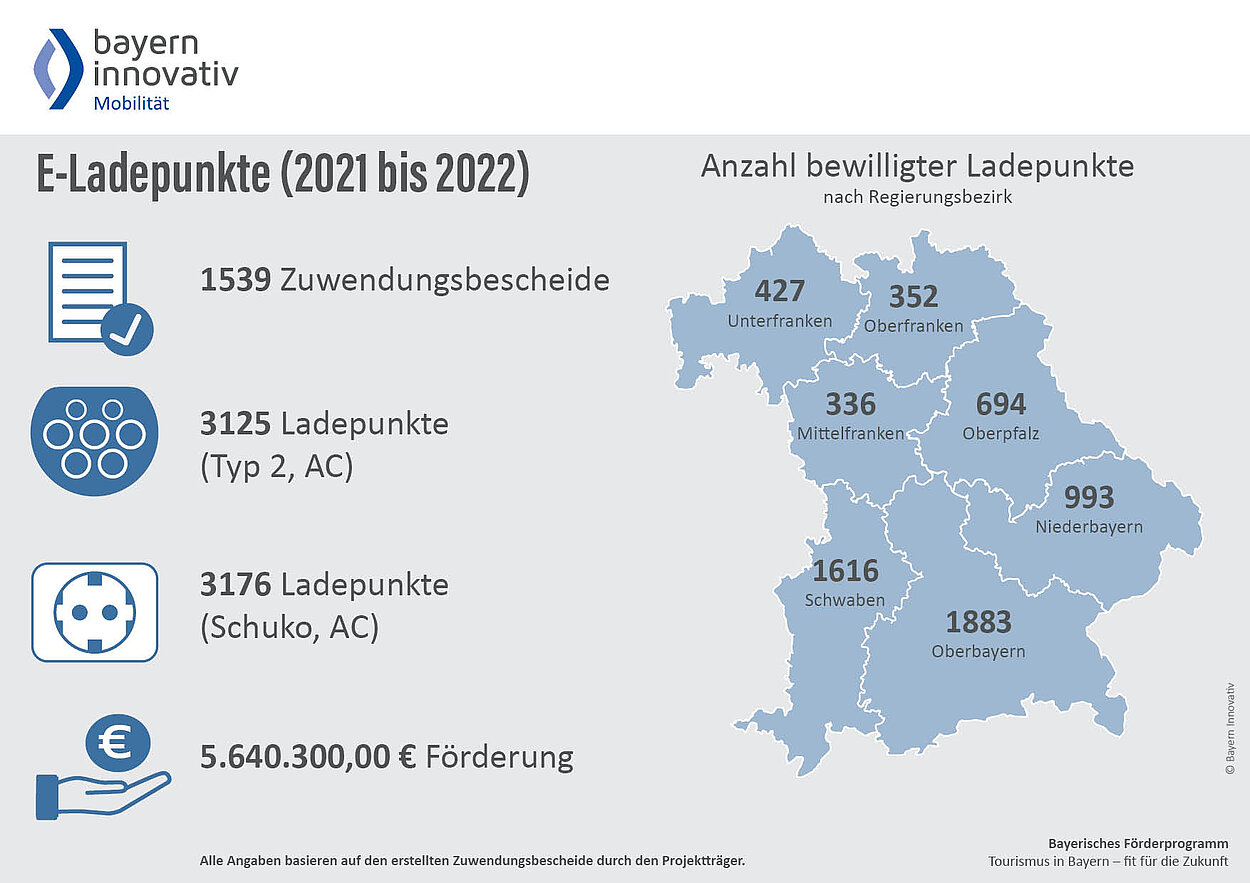
Against the backdrop of the coronavirus pandemic, the Free State of Bavaria is providing funding for sustainable, smart, barrier-free and ecological tourism as part of a de minimis measure. As part of the "Tourism in Bavaria - fit for the future" program, Bayern Innovativ GmbH is the project sponsor specifically for the "e-charging points" funding measure.
This funding program has been terminated. Accordingly, no new applications can be submitted.
Funding is provided for e-charging points for single and double-track electric vehicles at tourist businesses and tourist attractions in Bavaria. The Free State is providing funding of around 3 million euros for this purpose.
Who can submit an application?
Natural and legal persons who are active in the tourism sector, for example operators of hotels, vacation homes/apartments, restaurants and pubs, campsites or tourist attractions, are eligible to apply.
What is supported?
The object of the funding is the installation of stationary charging points for single-track (hereinafter referred to as pedelecs) and two-track (hereinafter referred to as electric vehicles) electric vehicles at tourist businesses and attractions in Bavaria, including the necessary grid connection.
In the case of e-vehicles, only charging points that are not publicly accessible are eligible for funding. A charging point is defined as not publicly accessible if only persons who must be known by name to the funding recipient may use the charging point, e.g. hotel guests (more under Frequently Asked Questions). In the case of pedelec charging points, both publicly accessible and non-publicly accessible charging points are eligible for funding.
What are the main requirements that must be met?
- Charging locations must be in Bavaria.
- The charging points to be set up must have a connection to tourism.
- Grants may only be approved for projects that have not yet been started. The start of the project is deemed to be the award of a delivery or service contract attributable to the execution of the project.
- Where necessary, the threshold value of the de minimis regulation must be taken into account when calculating the funding.
- The funded measure must be completed and invoiced by the end of 2022. The corresponding proof of use must be submitted by the end of 2022.
- Funded charging points must be communicated on the applicant's website in a way that is easy to find, where permissible.
- For e-vehicle charging points, the current version of the Charging Point Ordinance must be complied with.
- If the electricity is to be sold, the total charging costs must be based on the regional costs for publicly accessible charging points.
- A subsidy notice must be displayed at the charging point.
- The subsidized charging points/charging devices must be operated with 100% green electricity.
How is funding provided?
Funding is provided as proportional financing with a flat-rate upper limit as an earmarked grant in accordance with the proof of use to be submitted after the charging points have been put into operation.
- Charging devices for single-track electric vehicles (pedelecs, e-scooters, light electric vehicles, etc.) are funded with a maximum of EUR 300 per charging point.
- Charging facilities for two-track electric vehicles (e-cars, etc.) are subsidized with a maximum of 1,500 euros per charging point.
- The maximum number for both single-track and dual-track electric vehicles is ten charging points per charging location.
- The maximum funding amount is 90% of the eligible costs.
How can I apply for funding?
The program was closed on April 30, 2022. Only existing applications can still be processed.
Frequently asked questions:
Under this funding program, only electric vehicle charging points that are not publicly accessible are eligible for funding. With regard to the Charging Point Ordinance, the project sponsor is guided by the fact that the charging point user must be known by name or personally to the funding recipient with regard to their business activity. This should be specified by means of appropriate signage at the respective charging point.
For example, the following charging points are not considered publicly accessible and therefore eligible for funding:
- Charging points for hotel guests only
- Charging points only for restaurant guests with a confirmed reservation
- Charging point for registered groups only
For example, the following charging points are assessed as publicly accessible and therefore not eligible:
- Charging points for restaurant guests only
- Charging points for visitors or guests only
The funding program is subject to the general ancillary provisions for grants for project funding (ANBest-K for municipalities and ANBest-P for other actors). Contracts must therefore be awarded in accordance with competitive criteria and require at least three comparative offers from a total contract value of €5,000 net. Up to and including € 5,000 net, a contract can also be awarded directly, taking into account economy and efficiency.
Components purchased or services commissioned before the application is submitted are no longer eligible for funding. Within the scope of this funding program (purchase, order, commissioning, etc.), an early start of measures after the application has been submitted is no longer detrimental to funding. However, measures are commenced at the applicant's own risk before the grant notification is received, and no entitlement to funding can be derived from this.
As the majority of the requirements are already specified in the application form, we expect processing to be relatively quick. Depending on the current volume of applications, we try to send out the notifications within a few weeks of receiving the signed application by post.
Irrespective of this, it is no longer considered detrimental to funding in this program to start measures early once the application has been submitted digitally. However, this is at your own risk. This is because an entitlement to funding can only be derived from a funding decision and the requirements and legal framework defined therein.
Only the online application is sufficient for the application. No additional documents need to be uploaded.
The upload option only becomes relevant after the charging points have been installed or commissioned to document the costs incurred or as proof of implementation.
However, please do not forget to print out the online application, sign it and send it to us as a paper version.
The distinction between gross and net is not relevant for the flat-rate funding of €1,500 per electric car charging point or €300 per pedelec charging point.
In addition to the flat-rate funding, however, there is an upper percentage limit for the funding amount of a maximum of 90% of the eligible expenditure. The following applies when calculating eligible expenditure:
- Applicants who are entitled to deduct input tax shall state net amounts.
- Applicants who are not entitled to deduct input tax must state gross amounts.
The funding guideline does not specify any requirements for pedelec charging points, as the socket power is based on the usual VDE specifications anyway.
For electric car charging stations, the funding guideline requires a minimum charging power of at least 3.7 kW (single-phase connection). In addition, the funding guideline does not impose any restrictions in terms of charging power or plug standard as part of the charging station ordinance. This means that the charging points can be adapted to the specific needs of the respective customer groups, e.g. a DC fast charger (CCS) for guests in a hurry or several AC standard chargers (Type 2) for overnight guests. As a recommendation or for orientation, however, reference is made to the KfW 440 subsidy. Irrespective of this, the funding is always a flat rate of €1,500 per charging point or a maximum of 90% of the eligible expenditure.
The directive makes few specifications for pedelec charging points, as there are now a wide variety of products on the market that are suitable for charging pedelecs. However, eligible charging points must have a non-discriminatory or product-independent plug system. A type of locking system for fire and theft-proof storage of the charging power supply units is also recommended, as well as a holding and locking device for the pedelecs (bike stand). Additional features, such as a USB charging socket for cell phones etc., are not eligible for funding as an integral part of a stand-alone product. However, this does not affect the flat-rate subsidy of €300 per charging point. In the case of electric car charging points, only externally controllable charging devices are subsidized in order to be able to implement grid-compatible or intelligent charging in the future. A limitation to certain designs (wallbox or free-standing charging station) is not planned. For guidance on eligibility for funding, please refer to the corresponding wallbox list in the KfW 440 funding program. A comparable or higher-quality technology in charging station design is also eligible for funding.
The maximum funding ceiling of 90% relates to the eligible expenditure. This includes the expenses incurred when purchasing or installing the charging device, provided that these can be documented by invoice. Examples of eligible expenditure are listed in the funding guideline under 5.4 from sentence 8 onwards.
Non-eligible expenses include, for example, consultancy services, operating costs, own work or expenses for additional components that are not an integral part of the respective charging device or do not serve the actual purpose of charging a vehicle, such as planting, barriers in front of the parking/parking space or lockers for backpacks.
For newcomers to the topic of charging infrastructure, we offer a guide "Electric mobility in tourism" on this page under DOWNLOADS.
Natural and legal persons are eligible to apply for this funding program. This applies to many common company forms. In principle, GbRs are also eligible. However, the existence of the GbR and the signing authority of the applicant or applicants must be jointly documented (e.g. by submitting the partnership agreement). The relevant company form is requested in the application under "Master data". If your legal form is not listed, you can enter Other and specify the legal form in the text field, e.g. "Private rental".
The application concept stipulates that a loading location (postal address) is addressed in each application. Several applications can also be submitted for one charging location. In total, however, each charging location is limited to a maximum of 10 electric car and/or 10 pedelec charging points. An applicant can also submit several applications at different charging locations via their registration (master data).
The number of charging points applied for in an application can be changed before the funding decision is received. To do this, please contact the project sponsor. If the funding decision has already been issued, further applications can still be submitted within the upper charging point limits per charging location.
Initially, no commissioning or appointment may take place prior to the application for funding. After that, commissioning or ordering is no longer detrimental to funding, but you are only entitled to funding after receiving the grant notification.
The project must still be completed and settled in 2022, i.e. charging points installed and proof of use submitted. If this is not possible for unforeseeable reasons for which the applicant is not responsible, we urgently recommend timely coordination with the project sponsor.
Once the charging points have been commissioned, they must remain the property of the grant recipient for 5 years and be operated in accordance with the guidelines. After one year, a short report on the use of the charging points is due. The project sponsor will provide a document template for this purpose.
In principle, the funding guideline requires green electricity at the charging point at all times. Own PV electricity can be used. However, the supply of green electricity must be guaranteed even in poor solar or weather conditions. Therefore, a green electricity contract will generally also be necessary for existing PV systems. Seasonal or daily buffering of one's own PV electricity via the electricity grid or via a "gray electricity contract" is not classified as compliant with the subsidy. As many applicants still have a gray electricity contract and are bound by deadlines, the project sponsor defines the set-up in 2022 as the conversion phase. A corresponding green electricity contract would therefore have to be in place by the end of 2022 at the latest after the charging points have been commissioned or the proof of use has been submitted. Larger hotel facilities in particular sometimes have complex energy management systems and, in addition to PV systems, also use CHP units or their own buffer storage. If it can be proven that these systems were used to cover the previous energy requirements and the additional electricity for the charging infrastructure is covered by a green electricity contract, such energy concepts also appear to be eligible for funding.
The charging point is regarded as a final consumer and is no longer subject to the requirements of energy law. Therefore, the seller of "traction current" at a charging point does not automatically become an energy supplier. However, the relevant regulations must be observed when selling traction current, in particular calibration law or the Price Labeling Ordinance.
From the project sponsor's point of view, it is not relevant to the funding whether the charging current is sold or given away.
If the charging current is to be sold, the electricity costs must be based on the usual regional costs of public charging stations in order to avoid extortionate prices. In addition, the relevant legal requirements must be observed, in particular calibration law and price labeling regulations. This means, among other things:
- Electricity may only be billed according to kWh charged. Time-based tariffs are not permitted.
- The customer/guest must know the charging rate in advance, i.e. the cost per kWh.
- You must be able to provide the customer/guest with proof of the charged traction current. A corresponding electricity meter is required for this. Intelligent or controllable charging devices often already have a built-in MID meter, which can be read together with the guest at the charging point itself or via a data connection before and after the charging process.
As an option to selling electricity, you can also formally give away the charging current and charge a flat rate, e.g. for the "charging parking space", or offset it against the room costs. Tip: Today's electric cars consume between 6 and 24 kWh / 100 km. This means that the average electricity costs are around €5 per 100 km.
If the charging current is to be sold, a calibrated electricity meter is required. It is not permitted to sell electricity via time-based tariffs. Electricity meters with a rotor disk must be calibrated every 16 years; the calibration period for electronic meters (MID meters) is 8 years. Today's intelligent or controllable charging devices (e.g. wallbox) already have built-in MID meters, which can be read via a viewing window / display or via remote inquiry with the customer / guest.
An e-charging station, e.g. a wallbox, is a power supply device for electric vehicles and is classified as electrical equipment in accordance with IEC 6185. In this respect, charging devices must be tested by qualified electricians with demonstrable knowledge (initial and repeat tests). Publicly accessible charging points must be tested once a year. For further details, please consult your qualified electrician, who also carries out regular DGUV inspections, for example.
From the project sponsor's point of view, it is not relevant for funding purposes whether the charging device is connected directly to the domestic power supply or is supplied via a separate mains connection. However, you should consider the following
- Is the power draw of the house connection sufficient or are there still enough power reserves available? If not, it may be necessary to increase the output power or set up a separate grid connection for the charging device.
- A separate grid connection for the charging device may generate additional connection costs, but offers the possibility of separate calculation and a separate green electricity contract.
- Connecting the charging device to the existing house connection often limits the available charging capacity. A separate (integrated) electricity meter for each charging point is usually recommended. Linking home and charging power in this way also offers the opportunity to keep grid connection costs manageable via intelligent energy management or to integrate your own PV power (note possible subsidies for your own power).
- Intelligent load management can be used to significantly reduce or adjust the required connected load of the charging equipment in order to avoid additional costs due to excess power at the house connection.
No additional documents need to be uploaded with the application. It is sufficient to submit the application form (online and signed by post). No offers or cost estimates need to be submitted with the application. At least three comparative offers (from a total project volume of over € 5,000 net) can be obtained after the application has been submitted.